

Supporting Article (W1-S3-A7 · 7 of 7) | Antioxidants in Food: What They Are and What the Evidence Shows
1. What This Article Covers
Antioxidants in food have become one of the more widely discussed concepts in nutrition, but the term is often used loosely in ways that obscure what the evidence actually supports. These compounds are real, found in abundance in plant foods, and connected to cellular mechanisms that matter for long-term health. The evidence base for them is also more nuanced than popular coverage suggests.
This article covers what antioxidants are, how they work in the body at a biological level, which compounds and food sources are most relevant, and what the research shows about antioxidant-rich dietary patterns versus isolated antioxidant supplements. It does not address detox protocols, cancer treatment claims, or supplement dosing, which are outside the scope of general dietary guidance. For a broader introduction to micronutrients and their role in the diet, see Essential Vitamins and Minerals: A Research-Based Overview.
2. What Antioxidants Are and How They Work
Antioxidants are compounds that help protect cells from damage caused by free radicals — unstable molecules produced as byproducts of normal metabolism and by external factors like UV radiation, air pollution, and cigarette smoke. Free radicals are highly reactive: they can damage cell membranes, proteins, and DNA through a process called oxidative stress.
The body produces its own antioxidant defenses — enzymes and molecules that neutralize free radicals as part of normal physiology. Dietary antioxidants from food supplement these endogenous systems. When oxidative stress chronically exceeds the body’s defenses, cellular damage accumulates over time, which has been implicated in the development of chronic conditions including cardiovascular disease, certain cancers, and age-related changes.
It is worth being precise about what “antioxidants” means in a dietary context. The term refers not to a single compound but to a broad category of substances that share the property of electron donation — the chemical mechanism by which they neutralize free radicals. Different antioxidant compounds work in different cellular environments and through different pathways. This diversity is one reason why the concept of a “total antioxidant capacity” score for foods oversimplifies how they actually function in the body.
3. Key Antioxidant Compounds Found in Food
Several distinct families of antioxidant compounds appear in common foods:
Vitamin C (ascorbic acid). A water-soluble vitamin and potent antioxidant found in citrus fruit, berries, kiwi, bell peppers, and broccoli. It works primarily in aqueous (water-based) cellular environments and plays a role in regenerating other antioxidants, including vitamin E.
Vitamin E (tocopherols). A fat-soluble vitamin that protects cell membranes — the lipid-rich barriers surrounding cells — from oxidative damage. Found in nuts, seeds, vegetable oils, and leafy greens.
Beta-carotene and carotenoids. Pigment compounds found in orange, yellow, and red plant foods — carrots, sweet potatoes, tomatoes, pumpkin, and dark leafy greens. The body converts some beta-carotene to vitamin A, but the carotenoids also function independently as antioxidants.
Selenium. A trace mineral with antioxidant functions, incorporated into selenoproteins that are part of the body’s own antioxidant enzyme systems. Found in Brazil nuts, fish, eggs, and whole grains.
Polyphenols and flavonoids. A large and chemically diverse group of plant compounds that includes flavonoids, phenolic acids, stilbenes (including resveratrol), and lignans. Found in berries, tea, coffee, dark chocolate, red wine, apples, onions, and many other plant foods. Polyphenols are among the most studied dietary antioxidant families.
Lycopene. A carotenoid particularly abundant in tomatoes (especially cooked or processed), watermelon, and pink grapefruit. Associated in observational research with prostate and cardiovascular health outcomes.
4. Foods Richest in Antioxidant Compounds
No single food is uniquely essential — the evidence points to the importance of variety across antioxidant-rich food categories.
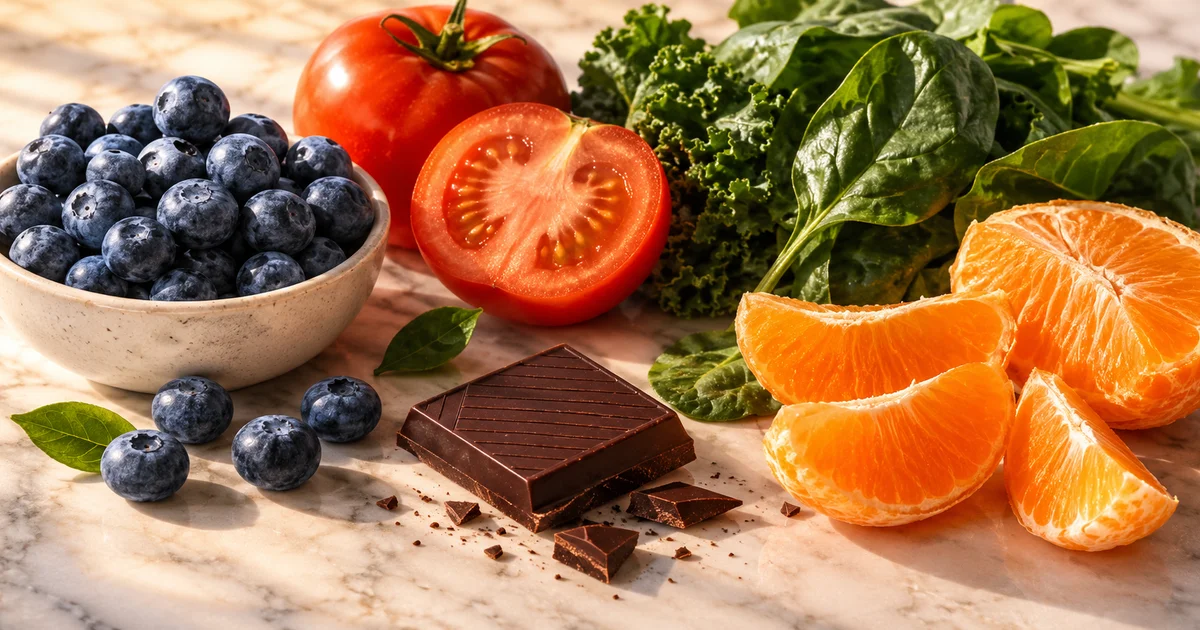
Berries. Blueberries, raspberries, strawberries, and blackberries consistently rank among the most antioxidant-dense foods by weight. Their color comes from anthocyanins, a flavonoid subgroup with well-studied biological activity.
Vegetables. Dark leafy greens (spinach, kale, Swiss chard), brassicas (broccoli, kale, Brussels sprouts), and alliums (onions, garlic) are among the most nutrient- and antioxidant-rich plant foods. Tomatoes are notable for lycopene.
Legumes. Beans and lentils contain polyphenols, flavonoids, and other compounds alongside their well-known protein and fiber content.
Nuts. Walnuts, pecans, and almonds are rich in vitamin E and polyphenols. A handful of mixed nuts contributes meaningfully to total daily antioxidant compound intake.
Tea and coffee. Both are among the most concentrated sources of polyphenols in typical Western diets — largely because they are consumed frequently and in quantity, not because they have uniquely high concentrations per gram.
Dark chocolate. High-cacao chocolate is a genuine source of flavonoids. As with coffee and tea, the research interest is proportionate to actual consumption patterns in many diets.
Spices and herbs. Turmeric, cinnamon, oregano, and cloves contain remarkably high concentrations of antioxidant compounds by weight. Given serving sizes, their actual contribution per meal is modest but cumulatively real across varied cooking.
5. What the Evidence Shows About Dietary Patterns
The strongest and most consistent human evidence for antioxidant-related health benefits comes not from individual antioxidant compounds in isolation, but from whole dietary patterns characterized by abundant antioxidant-rich foods.
The Mediterranean dietary pattern — rich in vegetables, fruit, legumes, nuts, olive oil, and whole grains — is one of the most extensively studied dietary frameworks in clinical nutrition. A large trial of adults at elevated cardiovascular risk found that those assigned to a Mediterranean diet supplemented with olive oil or nuts experienced a significantly lower rate of major cardiovascular events compared with those assigned to a reduced-fat diet, over approximately five years — findings confirmed in a corrected reanalysis after the original 2013 paper was retracted due to randomization irregularities (Estruch et al., 2018). The Mediterranean diet’s antioxidant-rich plant food components are among the proposed mechanisms for this benefit.
The clearest human evidence for benefits from antioxidant-related food choices comes from dietary pattern research, not from studies of individual compounds. The Mediterranean dietary pattern — characterized partly by its abundance of vegetables, fruits, legumes, nuts, and olive oil — has demonstrated reduced cardiovascular event rates in a major randomized trial. Whether this benefit reflects antioxidant compounds specifically, other bioactive compounds, fiber, healthy fats, or their combination is not fully disentangled in the evidence.
Observational research across many populations consistently finds that higher fruit and vegetable consumption is associated with lower risk of several chronic conditions. These associations are robust and replicated. They do not prove causation — people who eat more vegetables may differ from those who eat fewer in many other health-related ways — but the pattern is one of the most consistent in nutrition epidemiology.
6. Antioxidant Supplements: A Different Picture
A reasonable expectation, given the above, would be that taking antioxidant vitamins and minerals as supplements should reproduce or amplify the benefits seen in high-plant dietary patterns. The evidence on this is clear, and it does not support that expectation.
Multiple large systematic reviews of antioxidant supplement trials have found no consistent benefit from supplementation with antioxidants such as vitamin E, vitamin C, beta-carotene, and selenium for reducing all-cause mortality in healthy adults (Bjelakovic et al., 2007). More troublingly, some trials found that high-dose beta-carotene supplementation was associated with increased lung cancer risk in smokers — an effect that was not predicted from food-source beta-carotene research and that forced early termination of trials.
Several explanations have been proposed for this food-supplement divergence:
Matrix effects. Antioxidants in food do not arrive alone — they come embedded in a complex food matrix alongside fiber, other phytochemicals, co-factors, and nutrients that may be necessary for their biological activity. Isolated supplements replicate the compound but not the matrix.
Dose differences. Supplemental doses are often orders of magnitude higher than food-source concentrations, potentially overwhelming the body’s regulatory mechanisms rather than supporting them.
Oxidative balance. Free radicals are not uniformly harmful — some serve signaling functions in the body. High-dose antioxidant supplementation can disrupt these signaling roles in ways that food-source antioxidants at physiological concentrations do not.
The implication is not that antioxidants are ineffective, but that the food-source and supplement contexts are not equivalent. The benefits associated with antioxidant-rich food patterns are most reliably reproduced through antioxidant-rich food patterns, not through supplements designed to replicate individual components.
7. Practical Guidance
Eat a wide variety of plant foods. The evidence supports variety over concentration in one or two “superfoods.” Berries, dark leafy greens, legumes, nuts, vegetables of multiple colors, and whole grains together cover a broad range of antioxidant compound families.
Prioritize color in produce. Anthocyanins (purple/blue), carotenoids (orange/yellow/red), chlorophyll (green), and polyphenols (found across colors) each represent different antioxidant compound classes. A varied produce selection approximates diversity across these families more reliably than any single food.
Cook tomatoes for lycopene. Unlike most antioxidant compounds, lycopene in tomatoes becomes more bioavailable after cooking. Cooked tomatoes and tomato-based sauces are better lycopene sources than raw tomatoes.
Choose whole foods over antioxidant-enhanced products. “Added antioxidants” on a processed food label does not replicate the nutritional value of whole plant foods, and the health benefits from antioxidants in food appear to require the full food matrix.
Avoid relying on supplements for antioxidant intake. Based on the current evidence, the expected benefits from antioxidant supplements have not materialized in controlled trials, and some outcomes have been negative. Whole food sources remain the better-supported route for dietary antioxidants. Whether supplementation is appropriate for specific clinical circumstances is a determination for a healthcare provider.
A simple rule for antioxidants in food: the more color on your plate from whole plant foods, the better the coverage across antioxidant compound families. Berries with breakfast, dark greens at lunch or dinner, and a variety of colorful vegetables across the week covers the main bases without requiring any specific food counting.
8. Keep Reading
For an introduction to all essential vitamins and minerals — including vitamins C and E and the trace minerals with antioxidant functions — see Essential Vitamins and Minerals: A Research-Based Overview.
Several minerals share key food sources with antioxidant-rich plant foods. For how magnesium supports energy, muscle, and nerve function and which plant foods provide it most reliably, see Magnesium in the Diet: Functions and Food Sources.
Vitamin D interacts with overall immune and cellular health in ways that complement antioxidant nutrition. For what the research shows about vitamin D from food, sun exposure, and dietary sources, see Vitamin D: Food Sources, Sun Exposure, and What the Research Shows.
9. Frequently Asked Questions
Do antioxidant supplements improve health?
Large systematic reviews of antioxidant supplement trials have not found consistent health benefits from supplementation with isolated antioxidants such as vitamin E, vitamin C, and beta-carotene in healthy adults. Some trials found potential harm from high-dose beta-carotene supplementation in smokers. The benefits observed with antioxidant-rich dietary patterns have not been replicated by supplements, likely because food delivers antioxidant compounds within a broader nutritional context that isolated supplements do not reproduce. Whether supplementation is appropriate in specific clinical situations is a question for a healthcare provider.
Which foods have the most antioxidants?
Berries (blueberries, raspberries, blackberries) are among the most concentrated by weight. Other high-antioxidant foods include dark leafy greens, brassica vegetables, tomatoes, legumes, walnuts, pecans, dark chocolate, tea, and coffee. Spices and herbs (turmeric, cinnamon, oregano) are extremely concentrated per gram but are consumed in small amounts. Because antioxidant compounds are diverse and measured by different methods, ranking foods by a single score oversimplifies the picture — dietary variety across plant food categories is more practically useful than optimizing for one top-ranked food.
What is oxidative stress?
Oxidative stress describes the state in which free radical production in cells outpaces the body’s ability to neutralize them. Free radicals are highly reactive molecules — many produced as byproducts of normal metabolism, others from environmental exposures. When they accumulate, they can damage cell membranes, proteins, and DNA. Chronic oxidative stress has been implicated in the progression of cardiovascular disease and other conditions. Dietary antioxidants are one input to the body’s broader antioxidant defense systems, not a standalone treatment for any condition.
Is it better to eat fresh or cooked vegetables for antioxidants?
It depends on the compound. Most water-soluble antioxidants — including vitamin C and some polyphenols — are partially degraded by heat and leach into cooking water, so brief cooking or raw consumption preserves them better. Fat-soluble compounds like carotenoids and lycopene are often more bioavailable from cooked or processed foods, partly because heat breaks down plant cell walls and partly because fat aids their absorption. Practical takeaway: variety across both raw and cooked preparations is more useful than an all-or-nothing approach to either.
References
- Bjelakovic, G., et al. (2007). Mortality in randomized trials of antioxidant supplements for primary and secondary prevention: Systematic review and meta-analysis. JAMA, 297(8), 842–857. https://pubmed.ncbi.nlm.nih.gov/17308526/
- Estruch, R., et al. (2018). Primary Prevention of Cardiovascular Disease with a Mediterranean Diet Supplemented with Extra-Virgin Olive Oil or Nuts. New England Journal of Medicine, 378(25), e34. https://pubmed.ncbi.nlm.nih.gov/29897866/
This article was drafted with AI assistance and reviewed and approved by The Psychanatomy Editorial Team before publication.

