

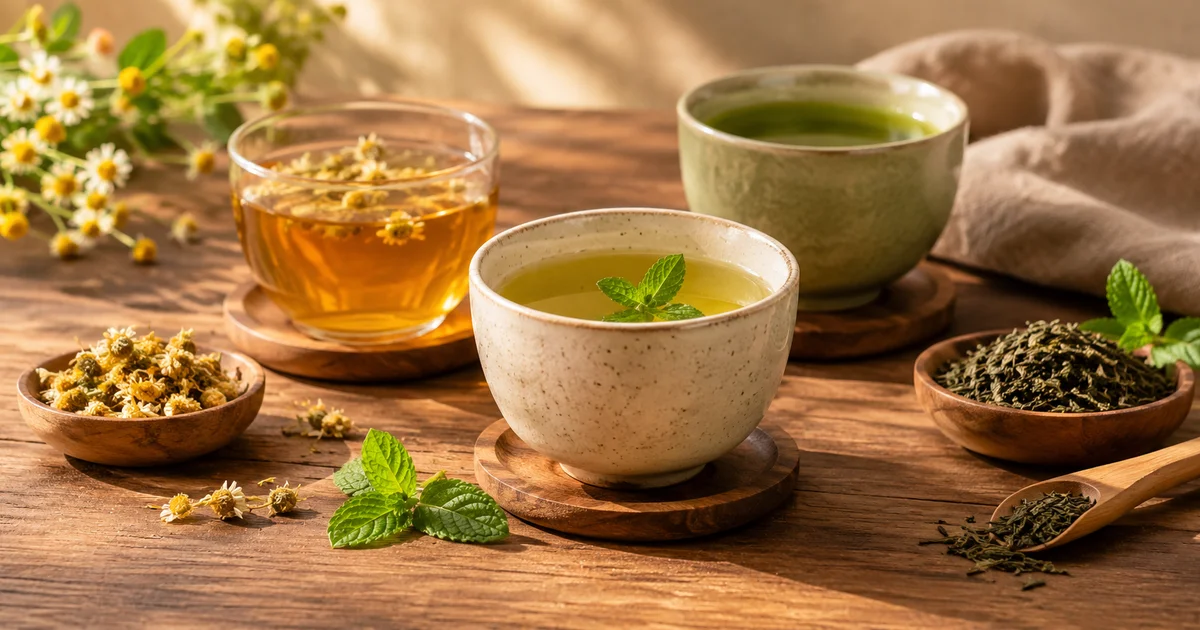
Supporting Article (W1-S5-A4 · 4 of 7) | Tea, Herbal Drinks, and Hydration
1. What This Article Covers
The relationship between tea herbal drinks and hydration is straightforward in one respect and more nuanced in another. The straightforward part: tea and most herbal drinks count toward your daily fluid intake and hydrate you effectively. The nuanced part: different types of tea — green, black, white, and herbal — have been studied for effects that go beyond their water content, particularly in relation to inflammation and metabolic markers.
This article covers what tea and herbal drinks contribute to daily hydration, what the research shows about their bioactive compounds, and practical guidance for including them in a well-hydrated diet. For the broader evidence on hydration and health — including how all beverage types fit into daily fluid needs — see Hydration and Health: What the Evidence Shows.
2. Tea, Herbal Drinks, and Daily Fluid Intake
Tea and herbal drinks are predominantly water by volume, which makes them effective contributors to daily hydration. The longstanding concern that caffeinated teas cause dehydration through caffeine’s diuretic properties is not supported by evidence for habitual drinkers. Habitual caffeine consumers develop tolerance to caffeine’s mild diuretic effect, and tea at typical consumption levels — a few cups daily — produces a net positive contribution to fluid intake.
Herbal teas (tisanes) are caffeine-free, so the diuretic concern does not apply at all. They are simply hot or cold water infused with plant material, and their hydration contribution is equivalent to plain water.
One distinction worth noting: tea and herbal drinks add flavor and, in some cases, bioactive compounds to what is fundamentally water. Whether those additional compounds affect health outcomes beyond their fluid contribution is a separate research question from hydration itself — and one the evidence is beginning to address.
3. Green Tea and Inflammation Research
Green tea is derived from the same plant as black and white tea (Camellia sinensis) but undergoes minimal oxidation, which preserves higher concentrations of catechins — a class of polyphenolic antioxidants. Much of the research interest in green tea has centered on these compounds and their potential anti-inflammatory effects.
A systematic review and meta-analysis examining green tea supplementation in people with type 2 diabetes found that it was associated with reduced C-reactive protein (CRP) — a standard marker of systemic inflammation — and improved oxidative stress biomarkers (Asbaghi et al., 2019). This research is valuable evidence about green tea’s effects in a clinical population, though the finding is specific to that population (people with type 2 diabetes) rather than a demonstration of the same effect in healthy adults.
The proposed mechanism involves catechins, particularly epigallocatechin gallate (EGCG), modulating inflammatory signaling pathways. Research on these mechanisms is active and ongoing. For general healthy adults, the anti-inflammatory research in clinical populations is relevant background, but cannot be directly extrapolated as a confirmed benefit.
4. Herbal Teas and Metabolic Research
Herbal teas — infusions of plants other than Camellia sinensis — encompass an extremely broad category. Chamomile, peppermint, ginger, hibiscus, cinnamon, and fenugreek are among dozens of plants used as herbal teas, each with different bioactive profiles and different bodies of research behind them.
A systematic review and meta-analysis of non-Camellia sinensis herbal teas in people with type 2 diabetes found associations with improvements in blood glucose levels and lipid markers — including fasting glucose and total cholesterol — compared to control groups (Alasvand Zarasvand et al., 2025). As with the green tea research, this finding comes from studies in a specific clinical population rather than general healthy adults, and the specific plants studied varied across the included trials.
The practical implication for general healthy adults is not that herbal teas are metabolic treatments, but that specific herbal teas have been studied in controlled research settings and show measurable effects on metabolic markers in clinical populations. This is a stronger evidence base than is sometimes recognized for beverages often thought of as primarily pleasant-tasting warm water.
5. What the Research Does and Does Not Show
Understanding what the tea and herbal drink evidence actually shows requires distinguishing between three different questions.
Does tea hydrate you? Yes, clearly. Tea and herbal drinks contribute meaningfully to daily fluid intake. This is the best-supported finding and applies to all types of tea.
Do green tea and herbal teas have health effects beyond their water content? The evidence in clinical populations (particularly type 2 diabetes) suggests yes, with some consistency. The effects on inflammation and metabolic markers in those populations are supported by systematic reviews. Whether the same effects occur in healthy adults at typical tea-drinking doses remains less established.
Should you drink tea specifically to treat or prevent a medical condition? No — and the research does not suggest this. The studies involve supplementation levels and clinical populations that are specific contexts, not prescriptions for general beverage habits.
6. Practical Guidance
For most healthy adults, the strongest practical point about tea and herbal drinks is simple: they are good options for meeting daily fluid needs, particularly for people who find plain water insufficiently interesting to drink in quantity.
Choose what you enjoy. There is no strong evidence that any specific variety of tea is significantly better for general healthy adults than others. Enjoying the drink is what will make it a sustainable part of daily hydration habits.
Understand caffeine content by tea type. Black tea contains the most caffeine among traditional teas, typically 40–70mg per cup. Green and white tea contain progressively less. Herbal teas are generally caffeine-free. If caffeine intake is a consideration for you — including for sleep — the type of tea matters for evening consumption.
Treat herbal teas as beverages, not treatments. The metabolic research in clinical populations is interesting, but herbal teas are not established treatments for any condition. If you have type 2 diabetes or another metabolic condition, your dietary choices belong in a conversation with your healthcare provider.
Tea and herbal drinks are among the most flexible ways to stay hydrated — widely available, calorie-free, and genuinely pleasant alternatives to plain water. If hydration is a goal, variety in beverage choice often helps maintain consistent intake.
7. Keep Reading
This article covers what tea and herbal drinks contribute to daily hydration and what the research shows about their bioactive compounds. For how coffee — another widely consumed caffeinated beverage — compares in terms of its evidence base, Coffee and Health: A Summary of the Research covers that in depth.
For the broader picture of hydration and health, including daily fluid needs and what happens when fluid intake is inadequate, Hydration and Health: What the Evidence Shows covers the full evidence landscape. For recognizing when hydration may be insufficient, Signs of Dehydration and How to Prevent Them covers the practical recognition and prevention side.
8. Frequently Asked Questions
Does tea count as water intake for hydration purposes?
Yes. Tea — both caffeinated and herbal — contributes to daily fluid intake. The concern that caffeinated tea causes net dehydration is not supported by evidence for habitual drinkers. Habitual caffeine consumers develop tolerance to caffeine’s mild diuretic effect, and tea at typical consumption levels produces a net positive contribution to hydration. Herbal teas are caffeine-free and hydrate identically to plain water.
Does green tea have health benefits beyond hydration?
Research in clinical populations — particularly people with type 2 diabetes — has found associations between green tea and reduced inflammatory markers and improved oxidative stress biomarkers. These findings come from systematic reviews of controlled studies. Whether the same effects occur reliably in healthy adults at everyday tea-drinking doses is less established. The hydration contribution is clear; the additional bioactive effects are supported by evidence in specific clinical contexts.
What is the difference between tea and herbal tea?
Traditional teas — green, black, white, and oolong — all come from Camellia sinensis, the tea plant, and vary mainly in how the leaves are processed. Green tea is minimally oxidized; black tea is fully oxidized. Herbal teas (also called tisanes) are infusions of plants other than Camellia sinensis — chamomile, peppermint, ginger, hibiscus, and many others. Herbal teas are caffeine-free; traditional teas contain varying amounts of caffeine depending on the variety and brewing time.
Is there an advantage to drinking tea herbal drinks and hydration over plain water?
For hydration specifically, no — plain water is equally effective and calorie-free. The potential advantage of tea and herbal drinks is that many people find them easier to drink consistently, which matters if plain water alone does not satisfy the goal of staying hydrated. Some herbal teas may also carry additional bioactive compounds with their own research interest, but that is separate from their hydration contribution.
References
- Asbaghi, O., Fouladvand, F., Moradi, S., Ashtary-Larky, D., Choghakhori, R., & Abbasnezhad, A. (2019). The effect of green tea on C-reactive protein and biomarkers of oxidative stress in patients with type 2 diabetes mellitus: A systematic review and meta-analysis. Complementary Therapies in Medicine, 46, 210–216. https://pubmed.ncbi.nlm.nih.gov/31519281/
- Alasvand Zarasvand, S., Mousavi, S., Khodaveisi, M., Sahraee, Z., & Kord-Varkaneh, H. (2025). Effects of Herbal Tea (Non-Camellia sinensis) on Glucose Homeostasis and Serum Lipids in Type 2 Diabetes Mellitus: A Systematic Review and Meta-Analysis. Nutrition Reviews, 83(2), e430–e442. https://pubmed.ncbi.nlm.nih.gov/38894639/
This article was drafted with AI assistance and reviewed and approved by The Psychanatomy Editorial Team before publication.

