

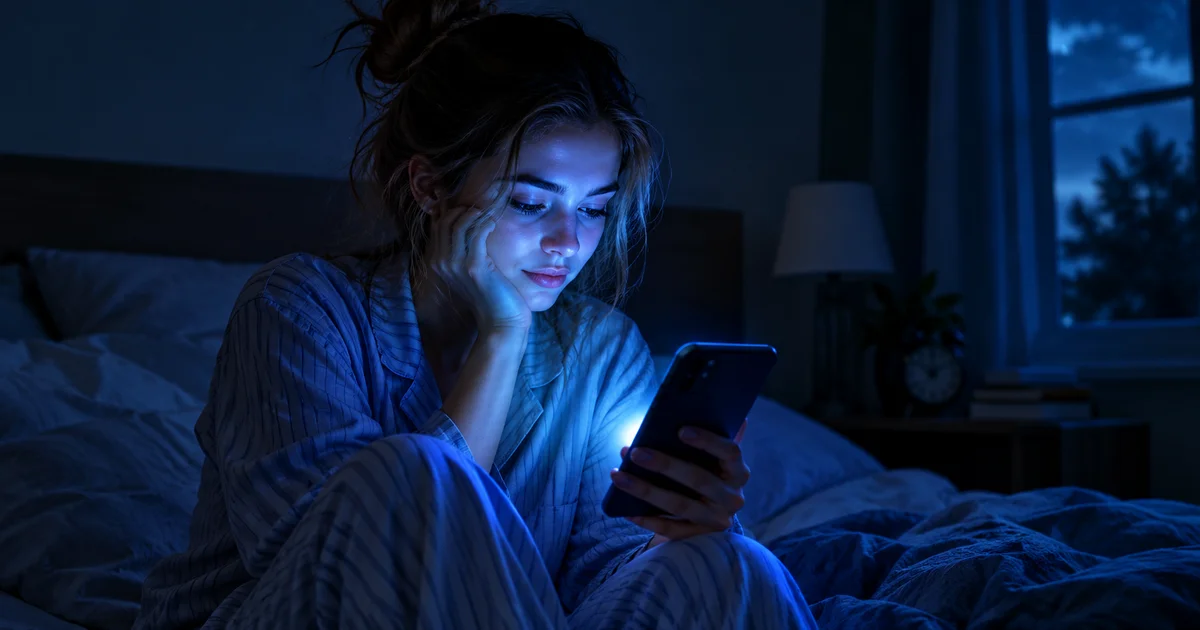
Supporting Article (W2-S2-A4 · 4 of 7) | Screen Time Before Bed: What the Research Shows
1. The Problem with Screens Before Bed
Screen time before bed refers to the use of backlit digital devices — smartphones, tablets, computers, and televisions — in the period leading up to sleep. It has become one of the most studied behavioral factors in sleep hygiene research over the past decade, as the proliferation of devices has made this behavior nearly universal in populations that struggle with sleep.
This behavior operates through two distinct pathways: light and content. The light emitted by backlit screens — particularly in the blue-wavelength range — can suppress melatonin production and shift the circadian clock. Separately, screen content that is engaging, emotionally activating, or interactive can delay the psychological wind-down needed for sleep onset, independent of any light effect.
This article focuses specifically on screen time before bed and its relationship to sleep. For the broader framework on building an effective pre-sleep routine, see Sleep Hygiene: An Evidence-Based Guide to Better Sleep.
2. What the Research Shows
Research in this area has accumulated substantially, with the most robust evidence coming from pediatric and adolescent populations.
A systematic review of bedroom sedentary behavior and sleep quality in children and youth found that having access to screens in the bedroom — including televisions, smartphones, and tablets — was associated with later sleep timing, shorter sleep duration, and worse sleep quality across studies (Saunders et al., 2022). This association was present for access alone, not only active use, suggesting that the presence of devices in the sleep environment has effects beyond just the light emitted during use.
A longitudinal systematic review of the determinants of children’s sleep behavior identified screen-based media use as one of the most consistently identified modifiable factors associated with poorer sleep outcomes across cohort studies (Belmon et al., 2019). The relationship was dose-dependent in many studies — more screen time was associated with greater sleep disruption.
The evidence in this area is strongest for children and adolescents, where multiple systematic reviews and longitudinal studies have found consistent associations with later sleep timing, reduced total sleep time, and lower sleep quality (Saunders et al., 2022; Belmon et al., 2019). Evidence in adults is more limited in quantity but directionally consistent, and the same physiological mechanisms apply — particularly blue-light-mediated melatonin suppression and the arousal effects of engaging content.
The adult evidence base is smaller and more methodologically mixed, but the biological mechanisms documented in pediatric research — circadian disruption from blue-wavelength light, arousal from stimulating content — are not age-specific. The same processes apply to adults.
3. The Two Mechanisms: Light and Content
Understanding why screen time before bed affects sleep requires separating the two mechanisms.
The light mechanism. Backlit digital screens emit light across the visible spectrum, with significant blue-wavelength content. Blue wavelengths are the most potent signal for the circadian clock, specifically for suppressing melatonin production in the evening. Research on light and melatonin suppression has established that even moderate levels of blue-rich light in the evening can delay melatonin onset by one to two hours in susceptible individuals.
The result is a delayed circadian phase: the body’s internal clock is shifted toward a later time, making it harder to fall asleep at the intended time, harder to wake up at the needed time, and potentially reducing total sleep opportunity even when time-in-bed remains the same.
The content mechanism. The second pathway is behavioral and psychological. Screen-based content — social media, news, games, videos — tends toward high engagement, emotional activation, and variable-reward patterns that make disengagement difficult. These properties maintain arousal and cognitive activation that are incompatible with the physiological state needed for sleep onset.
This mechanism operates independently of the light effect. A person using a device with a maximally dimmed, blue-filtered screen may still experience content-related arousal delay if the material they are engaging with is emotionally activating or requires active attention.
4. Device Access in the Bedroom as a Distinct Factor
One finding from the research worth highlighting separately is that device access in the bedroom appears to affect sleep independently of active use. Saunders et al. (2022) found that simply having devices accessible in the bedroom was associated with sleep disruption — a relationship that persists even when device use does not occur during the night.
The proposed explanation is behavioral availability: when a device is within reach, it is used. The activation of considering whether to use it, reaching for it on impulse, or responding to notifications all represent micro-interruptions that extend the sleep-onset period and can disrupt sleep maintenance.
The practical implication is that interventions targeting screen time before bed may be more effective when they address device location as well as active use duration. Keeping devices physically outside the bedroom — or at a minimum, screen-side down with notifications disabled — eliminates the access dimension of the problem entirely.
Research on parent-focused interventions for children’s screen use found that interventions addressing physical device access — rules about device-free bedrooms or overnight charging locations — were associated with improvements in sleep-related developmental outcomes alongside other outcomes in systematic review and meta-analysis (Machell et al., 2026). While this evidence is in pediatric populations, the behavioral principle about access and impulsive use is not age-specific.
5. Practical Strategies for Managing Device Use Before Bed
Managing device use before bed does not require eliminating all evening technology use. Effective strategies target the two mechanisms — light and content — and address the access dimension.
Addressing the light mechanism: – Use screen applications that shift display color toward warmer, red-shifted tones in the evening; most modern operating systems include this setting – Reduce screen brightness to the minimum comfortable level in the evening – Use external blackout features on devices (physically facing the screen away, or powering down) rather than relying entirely on software filtering, since software filters reduce but do not eliminate blue-light emission – Note that blue-light filtering glasses have a weaker evidence base than software-based filtering and room-level lighting changes; reducing light at the source is more effective than filtering it after emission
Addressing the content mechanism: – Establish a soft stop time for engaging or emotionally activating content — social media, news, episodic video — before sleep – Passive, low-engagement content (ambient video, instrumental playlists on a screen) produces less arousal delay than interactive or narrative-heavy content – Reading physical books or e-readers with warm-toned backlighting at low brightness produces less arousal than interactive screen content
Addressing device access: – Charge phones and tablets outside the bedroom overnight, eliminating both pre-sleep use and middle-of-night access – If the phone must be in the bedroom (for alarms or emergencies), use a do-not-disturb mode that silences all notifications except defined exceptions
For the wind-down routine context — what to do instead of screens in the final hour — see Building a Pre-Sleep Routine That Actually Works.
6. Limitations of the Current Evidence
The evidence in this area has limitations that are worth acknowledging.
The strongest studies are in children and adolescents, where parental oversight makes behavioral measurement more reliable and where sample sizes are larger. Adult studies face greater methodological challenges: self-reported screen use is unreliable, controlling for confounders in observational studies is difficult, and few RCTs have examined screen-use restriction in generally healthy adults specifically.
The magnitude of the effect also varies considerably in the literature, and individual differences in circadian sensitivity, melatonin physiology, and content engagement levels mean that blanket recommendations may not translate uniformly. Some individuals show minimal sleep sensitivity to evening screen use, while others appear highly sensitive.
The honest summary is: the association between heavy device use before bed and poorer sleep outcomes is well-supported, particularly in younger populations. The strength of the effect in any specific adult depends on their individual physiology and the specific content and device use patterns involved.
Moving the phone’s charging point outside the bedroom can reduce both bedtime use and overnight access. If device access appears to be affecting sleep, observing whether this change improves your routine can help clarify whether it is useful for you.
7. Keep Reading
For the full sleep hygiene framework — including sleep schedules, alcohol, napping, and the sleep environment — see Sleep Hygiene: An Evidence-Based Guide to Better Sleep.
For practical guidance on building an evidence-based wind-down routine that addresses what to do in place of screens, see Building a Pre-Sleep Routine That Actually Works.
For the research on physical sleep environment factors that complement behavioral screen management, see Mattress, Pillow, and Bedding Basics: What the Evidence Says About Sleep Quality.
8. Frequently Asked Questions
How much screen time before bed is too much?
No specific threshold has been established that applies equally to all adults. Research supports the general principle that reducing device use before sleep may reduce sleep disruption, particularly when it also reduces bright-light exposure and stimulating content. The evidence in adults is less definitive than in pediatric populations, and individual sensitivity varies. If screen use in the evening does not appear to affect your sleep onset, it may not require change.
Does a blue-light filter on my phone actually help with sleep?
Blue-light filtering applications shift screen color toward warmer tones and reduce — but do not eliminate — blue-wavelength light emission. Research on these filters specifically shows mixed results for sleep outcomes. The filtering approach is likely more beneficial than no mitigation, but less effective than actually reducing screen time, since it does not address the content-arousal pathway and only partially addresses the light pathway. Combined with reducing screen brightness and limiting engaging content, filtering is a useful component of an overall strategy rather than a complete solution.
Is watching TV in bed worse than using a phone?
Television and smartphone use before bed have different profiles of concern. Television typically involves more passive viewing with the screen at a greater distance, potentially producing less individual arousal. Smartphones involve active, proximate engagement and are more commonly used in bed with notifications active. Research on device type and sleep outcomes suggests smartphones and tablets in the bedroom are associated with greater sleep disruption than background television, though both are associated with worse sleep compared to no device use. Individual content matters as much as device type.
What about reading on a tablet or e-reader?
Tablets and e-readers produce light in the same range as other backlit screens. Reading on an e-reader with a warm-toned backlight at low brightness produces less blue-light exposure than typical tablet or phone use. The content of reading — passive narrative, low engagement, non-interactive — produces less arousal than social media or interactive applications. Reading on a backlit device is likely a lower-disruption option than interactive screen content, but physical books or e-ink (non-backlit) readers at a warm lamp are lower-disruption still.
My child uses devices in their bedroom. Is the evidence strong enough to make a rule about it?
The evidence for pediatric populations is among the strongest in screen-time-and-sleep research. Multiple systematic reviews have found consistent associations between bedroom device access and shorter sleep duration and worse sleep quality in children and adolescents (Saunders et al., 2022; Belmon et al., 2019). Interventions targeting physical device access in the bedroom have shown improvements in sleep-related outcomes in children in systematic review (Machell et al., 2026). The evidence is strong enough to support a family rule about device charging locations outside the bedroom. A pediatrician can offer tailored guidance for specific age groups and situations.
References
- Saunders TJ et al. (2022). Timing of sedentary behaviour and access to sedentary activities in the bedroom and their association with sleep quality and duration in children and youth: a systematic review. Health promotion and chronic disease prevention in Canada. https://pubmed.ncbi.nlm.nih.gov/35481336/
- Belmon LS et al. (2019). What are the determinants of children’s sleep behavior? A systematic review of longitudinal studies. Sleep medicine reviews. https://pubmed.ncbi.nlm.nih.gov/30529431/
- Machell A et al. (2026). Effect of parent-focused interventions for screen use on developmental outcomes in young children: a systematic review and meta-analysis. The international journal of behavioral nutrition and physical activity. https://pubmed.ncbi.nlm.nih.gov/42163356/
This article was drafted with AI assistance and reviewed and approved by The Psychanatomy Editorial Team before publication.

