

Supporting Article (W1-S3-A4 · 4 of 7) | Calcium and Bone Health: Sources Beyond Dairy
1. What This Article Covers
Calcium and bone health are closely connected — this mineral is the primary structural component of bone tissue, and adequate calcium intake over a lifetime influences how dense and resilient bones become and remain. For most people, dairy products are the most familiar calcium sources. But dairy is not necessary to meet calcium needs, and understanding the full range of alternatives opens up practical flexibility.
This article focuses on the evidence connecting dietary calcium to bone health, which foods outside of dairy provide meaningful amounts, and how absorption varies depending on food choice and context. It does not cover calcium supplementation protocols, vitamin D synthesis, or the clinical management of osteoporosis — those require individual healthcare consultation and fall outside educational dietary guidance. For a broader introduction to minerals and micronutrients across the diet, see Essential Vitamins and Minerals: A Research-Based Overview.
2. The Evidence: Calcium Intake and Bone Mineral Density
Bone mineral density is the most commonly used measure of bone strength, and calcium intake is one of the more thoroughly studied dietary factors that influences it. A systematic review and meta-analysis found a positive association between dietary calcium intake and bone mineral density at multiple skeletal sites across age groups — in children, adolescents, and older adults (Tai et al., 2015). The associations were modest but consistent.
The relationship is not linear. Below adequate intake, increasing calcium is associated with meaningful gains in bone density. Above adequacy, additional calcium from food contributes diminishing returns, and high supplemental doses raise questions about safety and cardiovascular risk that do not apply to food-source calcium. Understanding this distinction matters: the evidence for food-source calcium and bone health is more straightforward than the evidence for supplemental calcium.
Systematic review evidence supports a positive link between dietary calcium intake and bone mineral density, particularly during growth years and in older adults at risk for bone loss. Food-source calcium is consistently better supported than supplemental calcium, both for effect size and for safety considerations.
Peak bone mass — the maximum density a person reaches in young adulthood — is another key factor in long-term bone health. Research on lifestyle factors influencing its development found that calcium intake and physical activity during adolescence and early adulthood are among the most influential determinants of lifelong bone strength (Weaver et al., 2016). Dietary choices during those years have structural consequences that extend for decades.
3. Non-Dairy Calcium Sources
Several plant and animal foods outside the dairy category provide meaningful calcium:
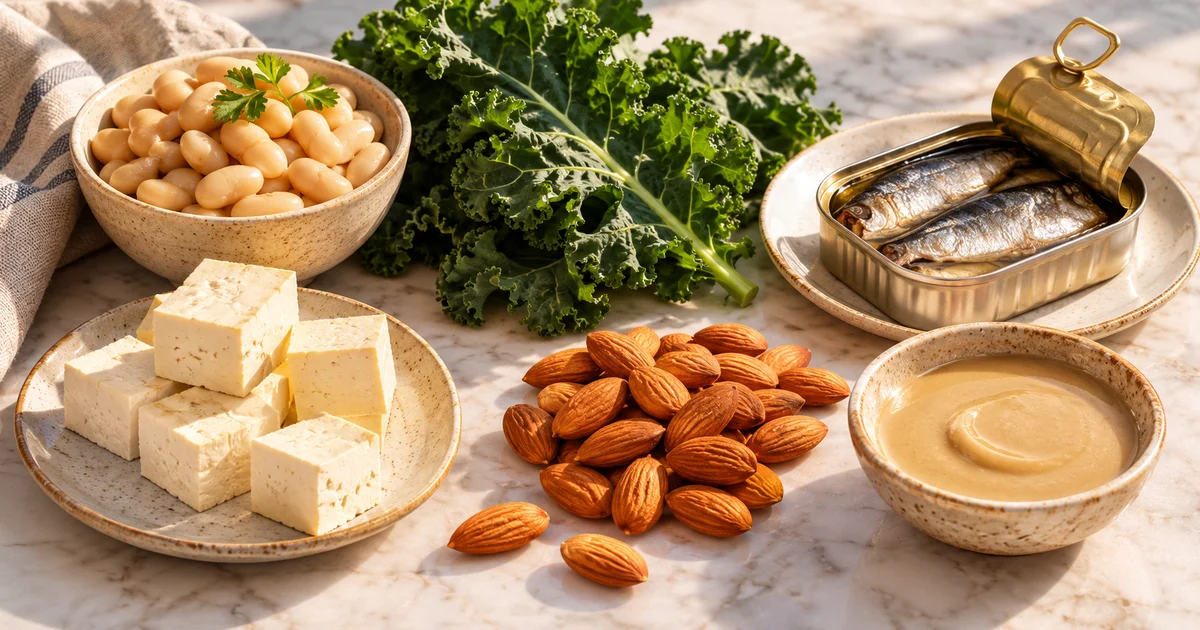
Leafy green vegetables. Kale, bok choy, broccoli, and collard greens are among the better plant-based sources. An important distinction: some greens — particularly spinach and Swiss chard — are high in oxalates, which bind calcium and substantially reduce absorption. Kale and bok choy have much lower oxalate content and deliver more bioavailable calcium per serving.
Legumes and soy products. White beans, chickpeas, and black beans provide moderate calcium. Tofu made with calcium sulfate (check the label, as preparation method matters significantly) can be an excellent source. Tempeh also contributes calcium, as does edamame in smaller amounts.
Canned fish with bones. Sardines and canned salmon eaten with their soft, edible bones are among the most concentrated non-dairy animal calcium sources. The calcium in these bones is highly bioavailable and comparable to dairy.
Fortified foods. Plant-based milk alternatives — oat, almond, soy — are often fortified with calcium to levels matching cow’s milk, though formulations vary considerably by brand. Fortified orange juice is another option. The bioavailability of calcium from fortified foods is generally comparable to dairy.
Nuts and seeds. Almonds, sesame seeds (including tahini), and chia seeds contribute usefully to total daily intake. While no single serving is highly concentrated, they add cumulatively across varied meals.
Dried figs. Among fruits, dried figs offer a notable contribution. A small handful adds meaningfully to daily intake.
4. How Calcium Absorption Works
Not all dietary calcium is equally absorbed. Several factors affect how much actually reaches the bloodstream:
Vitamin D status. Vitamin D promotes active calcium absorption in the small intestine. Without adequate vitamin D, absorption efficiency declines significantly regardless of the calcium source. This is why these two nutrients are so often discussed together — their functional interaction is real.
Oxalates and phytates. As noted above, some plant foods — spinach, beet greens, rhubarb — contain oxalates that bind calcium and limit absorption. Whole grains and some legumes also contain phytates that partially inhibit calcium uptake. Cooking reduces these compounds somewhat. Practically, diversifying calcium sources is more useful than avoiding these foods entirely; spinach is still nutritious, it simply does not function efficiently as a calcium source.
Dose at one meal. The body absorbs calcium most efficiently when intake at a single sitting is around 500 mg or less. Spreading calcium intake across meals — rather than consuming it all at once — improves overall daily absorption.
Age. Calcium absorption efficiency declines with age. Postmenopausal women and older men are at heightened risk for bone loss partly because of this reduced absorption capacity alongside lower average dietary intake.
Caffeine. High caffeine intake has a modest calcium-excretion effect via the kidneys. For people with moderate caffeine consumption (two to three cups of coffee per day) whose overall calcium intake is adequate, this effect is unlikely to significantly affect bone health. It becomes more relevant when calcium intake is also marginal.
5. Building a Calcium-Adequate Diet Without Dairy
Meeting calcium needs through food without dairy is practical with some consistent food choices.
Include two or three calcium-rich foods each day. Adult calcium needs are generally in the 1,000–1,200 mg range per day depending on age. No single food needs to supply the full amount. A bowl of calcium-fortified oat or soy milk at breakfast, a serving of calcium-set tofu or canned sardines at lunch, and a side of cooked kale or white beans at dinner can together provide a substantial portion of the day’s target.
Check labels on fortified foods. Calcium content in plant-based milk alternatives varies widely. Some match dairy; others contain minimal amounts. The nutrition label is the only reliable guide. Look for products with at least 30% of the daily value per serving to approach cow’s milk equivalence.
Choose lower-oxalate greens for calcium. When building plant-forward meals with calcium in mind, kale, broccoli, and bok choy are more efficient calcium contributors than spinach. This is not a reason to eliminate spinach — it has genuine nutritional value — but it should not be the primary calcium strategy.
Address vitamin D status. Calcium and vitamin D work together for bone health. If vitamin D status is insufficient — which is common in many populations — the dietary calcium you consume may not be absorbed as effectively. A healthcare provider can assess vitamin D status with a blood test.
If you use plant-based milk alternatives as a dairy substitute, prioritize versions fortified with both calcium and vitamin D. Many fortified plant milks provide both, making them among the more practical non-dairy options for supporting calcium and bone health together.
6. Keep Reading
For an introduction to all essential vitamins and minerals, including calcium’s place in the full micronutrient landscape, see Essential Vitamins and Minerals: A Research-Based Overview.
Several minerals affect each other’s absorption at the meal level — including calcium and iron. For strategies around iron-rich foods and how to structure meals for better mineral uptake overall, see Iron-Rich Foods and How to Maximize Absorption.
For how other B vitamins support energy metabolism, nervous system function, and cellular processes — with practical food sources for each — see B Vitamins: What They Do and Where to Find Them.
7. Frequently Asked Questions
Is plant-based calcium as effective as dairy calcium for bones?
Several plant-based sources — particularly low-oxalate greens, calcium-set tofu, canned fish with soft bones, and fortified plant milks — provide calcium that is absorbed at rates broadly comparable to dairy. Spinach and some other greens are exceptions because of high oxalate content. The key factor is not dairy versus plant-based per se, but which specific foods are chosen and how they are prepared. A varied approach drawing on multiple plant-based sources is more reliable than any single food.
How much calcium do adults need each day?
For most adults under 50, standard guidelines specify around 1,000 mg per day from food and drink. For adults over 50 — particularly postmenopausal women — recommendations typically increase to 1,200 mg per day to compensate for reduced absorption efficiency and higher bone loss rates. These are population-level estimates; individual needs vary, and healthcare providers are the appropriate source for personalized guidance.
Do calcium supplements reduce fracture risk?
The evidence on calcium supplementation and fracture prevention is more uncertain than the evidence on dietary calcium and bone mineral density. Some large systematic reviews and meta-analyses have found little benefit from calcium supplementation alone on fracture incidence in community-dwelling older adults (Zhao et al., 2017), while also raising questions about potential cardiovascular effects at high supplemental doses. For most people, prioritizing dietary calcium is the better-evidenced approach. Whether supplementation is appropriate for any individual is a determination for a healthcare provider based on current dietary intake, bone density, and overall health.
Can you get enough calcium on a fully plant-based diet?
A well-planned plant-based diet can meet calcium needs. The practical requirements are incorporating reliable plant sources consistently — fortified plant milks, calcium-set tofu, white beans, kale, bok choy, canned fish for pescatarians — and maintaining adequate vitamin D status to support absorption. Meeting calcium needs on a plant-based diet requires more intentionality than simply consuming dairy, but it is achievable with sustained attention to food choices.
References
- Tai, V., et al. (2015). Calcium intake and bone mineral density: Systematic review and meta-analysis. BMJ, 351, h4183. https://pubmed.ncbi.nlm.nih.gov/26420598/
- Weaver, C. M., et al. (2016). The National Osteoporosis Foundation’s position statement on peak bone mass development and lifestyle factors: A systematic review and implementation recommendations. Osteoporosis International, 27(4), 1281–1386. https://pubmed.ncbi.nlm.nih.gov/26856587/
- Zhao, J. G., et al. (2017). Association between calcium or vitamin D supplementation and fracture incidence in community-dwelling older adults: A systematic review and meta-analysis. JAMA, 318(24), 2466–2482. https://pubmed.ncbi.nlm.nih.gov/29279934/
This article was drafted with AI assistance and reviewed and approved by The Psychanatomy Editorial Team before publication.

