
Supporting Article (W1-S3-A5 · 5 of 7) | B Vitamins: What They Do and Where to Find Them
1. What This Article Covers
B vitamins are a family of eight water-soluble nutrients that the body uses for energy metabolism, nervous system function, and the production of red blood cells. Unlike fat-soluble vitamins, they are not stored in large amounts in the body, which means regular dietary intake matters for maintaining adequate levels.
This article covers what each nutrient in this group does individually and collectively, which foods are the most reliable sources, and two specific considerations — B12 for people who eat limited animal foods, and folate in the context of pregnancy. It does not cover clinical assessment or treatment of deficiency conditions for these nutrients, which are medical topics outside the scope of general dietary guidance. For an overview of all essential vitamins and minerals in the diet, see Essential Vitamins and Minerals: A Research-Based Overview.
2. Roles and Functions Across the Family
There are eight distinct nutrients in this family, each with specific roles. As a group, they are best known for energy metabolism — most are involved in the biochemical reactions that convert carbohydrates, fats, and proteins into usable cellular energy. Beyond that collective role, each has additional functions:
B1 (Thiamine) — Required for carbohydrate metabolism and nervous system function. Found in whole grains, legumes, and pork.
B2 (Riboflavin) — Participates in cellular energy production and supports antioxidant processes. Found in dairy products, eggs, lean meats, and leafy greens.
B3 (Niacin) — Involved in energy metabolism and DNA repair. Found in poultry, fish, beef, peanuts, and whole grains.
B5 (Pantothenic Acid) — Required for the synthesis of coenzyme A, which is central to fat metabolism. Widely distributed across many foods, including meat, vegetables, and grains.
B6 (Pyridoxine) — Involved in protein metabolism, neurotransmitter synthesis, and immune function. Found in poultry, fish, potatoes, and bananas.
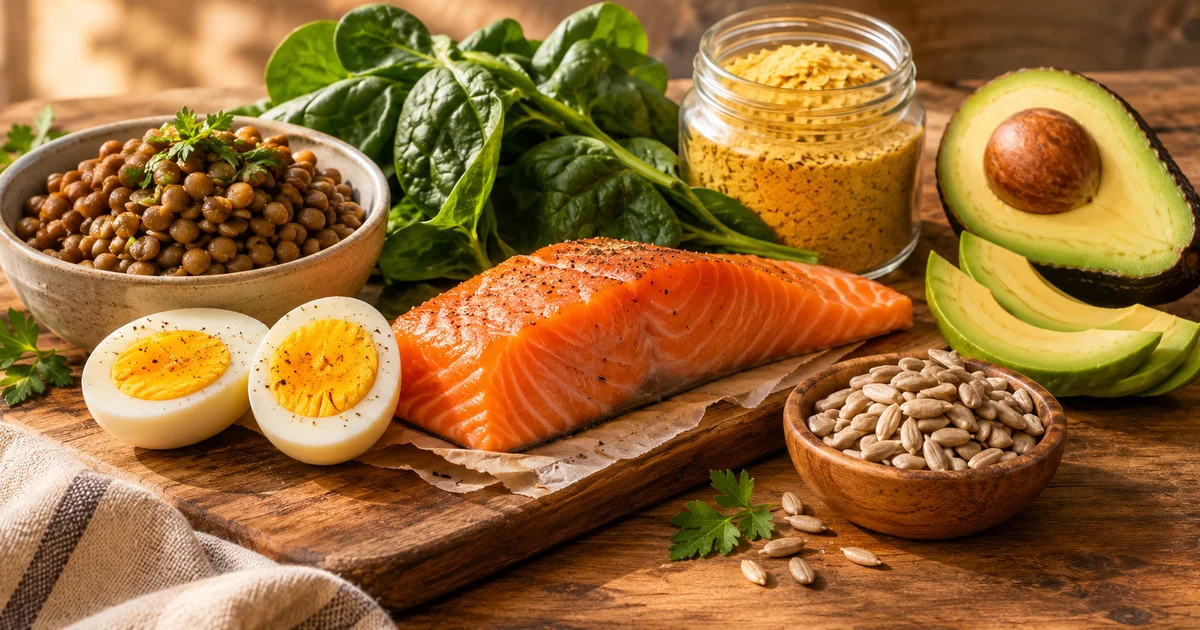
B7 (Biotin) — Supports fat, carbohydrate, and protein metabolism. Found in cooked egg yolks, nuts, seeds, and salmon.
B9 (Folate) — Required for DNA synthesis, cell division, and amino acid metabolism. Found in dark leafy greens, legumes, fortified grains, and citrus.
B12 (Cobalamin) — Essential for red blood cell formation, neurological function, and DNA synthesis. Found almost exclusively in animal products — meat, fish, dairy, and eggs — and in fortified foods.
3. Where to Find These Nutrients
No single food provides the full B vitamin range. A varied diet drawing from several food categories covers the family most reliably:
Whole grains. Brown rice, oats, whole wheat bread, and fortified breakfast cereals are particularly rich in B1, B3, and B6. Grain fortification policies mean that many processed grain products are also a source of several B vitamins, including folic acid.
Animal foods. Meat, poultry, fish, eggs, and dairy together cover the broadest range. B12 is found almost exclusively in this category. Lean beef, chicken, salmon, and tuna are strong sources of B3, B6, and B12.
Legumes. Chickpeas, lentils, black beans, and kidney beans are excellent folate and B1 sources. They also contribute meaningful B3 and B6.
Leafy greens. Spinach, asparagus, and romaine lettuce are among the most folate-dense plant foods. They also contribute smaller amounts of B2 and B6.
Nuts and seeds. Sunflower seeds, almonds, and peanuts are notable B3 and B6 sources. Sunflower seeds are one of the more concentrated B5 sources in common diets.
Eggs and dairy. Both provide B2, B12, and B5. Cooked egg yolks are a reliable biotin source.
4. Vitamin B12 and Plant-Based Diets
B12 occupies a special position in this family of nutrients because it is found almost exclusively in animal products. Fermented plant foods, algae, and some fortified products contain small amounts, but the evidence for algae-sourced B12 as a reliable dietary source is inconsistent.
People who follow fully plant-based diets — or who eat very limited animal products — are at significantly higher risk of B12 insufficiency over time. Because B12 deficiency develops slowly (the body stores modest reserves), it may take years to become clinically apparent, and neurological damage from severe deficiency can be difficult to reverse.
The practical options for people who eat no animal products are fortified foods (plant-based milks, nutritional yeast, some breakfast cereals) and supplementation. Older adults are also at elevated risk regardless of diet, because the ability to absorb B12 from food-bound sources declines with age — crystalline B12 in fortified foods and supplements is absorbed more reliably. Whether supplementation is appropriate, and in what form, is a determination for a healthcare provider.
B12 is the one member of this group for which dietary adequacy genuinely depends on food category rather than just variety. For people who eat no or very limited animal foods, relying on naturally occurring plant-source B12 is not sufficient — fortified foods or supplementation, confirmed with a healthcare provider, are the practical route.
5. Folate, Folic Acid, and Pregnancy
Folate is the naturally occurring form of B9 found in food. Folic acid is the synthetic form used in supplements and food fortification. The body converts both to active folate, and in most contexts the distinction is metabolically minor. For a small percentage of people with specific genetic variants affecting folate metabolism, the difference may matter more — a healthcare provider can advise.
The richest dietary folate sources are dark leafy greens (spinach, asparagus, romaine), legumes (lentils, chickpeas, black beans), and citrus fruit. Fortified grain products are another major source in many diets, due to mandatory folic acid fortification policies in place in many countries.
Research — including a randomized controlled trial that found periconceptional folic acid supplementation associated with reduced occurrence of neural tube defects (Czeizel & Dudás, 1992) — has informed clinical guidance around the periconceptional period. Folate needs increase during pregnancy, and current prenatal guidance may include supplemental folic acid; readers who are pregnant or planning pregnancy should follow current healthcare guidance.
6. B Vitamins and Cognitive Function
Several of these nutrients — particularly B6, folate (B9), and B12 — are involved in the metabolism of homocysteine, an amino acid that accumulates when they are deficient. Elevated homocysteine has been associated with cognitive decline, which has driven sustained research interest in whether supplementing these vitamins can protect cognitive function over time.
The overall evidence is nuanced. A Cochrane systematic review of supplementation for cognitive maintenance in people without pre-existing diagnoses found that the evidence does not support a consistent cognitive benefit from supplementation in the general healthy adult population (Rutjes et al., 2018). Where effects have been found, they appear strongest in populations with measurable deficiency or elevated homocysteine at baseline — consistent with a deficiency-correction effect rather than a benefit beyond adequacy.
The dietary implication is straightforward: maintaining adequate intake of these nutrients through food is the appropriate approach. The research base is not a case for high-dose supplementation in well-nourished adults; it is a case for not falling deficient.
7. Practical Guidance
Prioritize variety across food groups. For most people eating a varied diet that includes whole grains, legumes, leafy greens, and some animal protein, dietary needs for this nutrient family are well-covered. The family’s distribution across many food categories means deficiency in healthy adults eating varied diets is relatively uncommon — the clear exceptions are B12 in plant-based diets and folate for people planning pregnancy.
Choose whole grains where practical. Processing removes most naturally occurring B vitamins from refined grains, even when some are added back through fortification. Whole grains retain more B1, B3, and B6 in their natural form.
Use legumes and greens for folate. Dark leafy greens and legumes are the most reliable high-folate plant foods in most diets. Consistent inclusion — a few servings per week across both categories — builds a solid dietary folate foundation.
Plant-based eaters: address B12 intentionally. This is the one member of this family where dietary category genuinely changes risk. Regular use of B12-fortified foods or supplementation, confirmed with a healthcare provider, is the appropriate approach.
Nutritional yeast — often used to add a savory, cheese-like flavor to plant-based dishes — is commonly fortified with multiple B vitamins including B12. It is not a substitute for confirmed B12 supplementation in fully plant-based diets, but it adds a useful contribution to B vitamin intake in plant-forward meals.
8. Keep Reading
For an introduction to all essential vitamins and minerals — including how this family of nutrients fits alongside minerals and fat-soluble vitamins in a complete dietary picture — see Essential Vitamins and Minerals: A Research-Based Overview.
Minerals such as calcium work alongside B vitamins to support bone health and physical function. For how calcium supports bone structure and which non-dairy sources are most reliable, see Calcium and Bone Health: Sources Beyond Dairy.
For how magnesium supports muscle, nerve, and metabolic function alongside the B vitamin family — with practical food sources — see Magnesium in the Diet: Functions and Food Sources.
9. Frequently Asked Questions
Do I need a B vitamin supplement?
For most people eating a varied diet, dietary sources cover this family of nutrients adequately. The cases where supplementation most clearly applies are: B12 for people who follow fully plant-based diets or have confirmed deficiency; and folic acid supplementation during the periconceptional period, per current clinical guidance. For other nutrients in this family, supplementation in healthy adults without confirmed deficiency has limited evidence for benefit beyond dietary adequacy. A healthcare provider can assess status with a blood test if there are concerns.
Which foods have the most B12?
Clams and oysters are among the most concentrated B12 sources per gram. Beef liver, fatty fish (salmon, trout, tuna), beef, pork, and dairy products (milk, yogurt, cheese) are also reliable sources. For plant-based eaters, fortified foods — plant milks, some breakfast cereals, nutritional yeast — are the practical alternatives, with specific amounts varying by product and brand. Labels are the most reliable guide to B12 content in fortified foods.
What are signs of B vitamin deficiency?
Different B vitamin deficiencies produce different symptoms. B12 deficiency can cause fatigue, neurological symptoms (tingling, numbness, cognitive difficulties), and a specific form of anemia. Folate deficiency also causes anemia, and insufficient folate during early pregnancy is associated with increased neural tube defect risk. B1 deficiency (thiamine) is associated with neurological and cardiovascular complications, particularly in contexts of poor dietary quality or alcohol dependence. Because these symptoms overlap with many other conditions, a healthcare provider and blood tests are the appropriate route for diagnosis — not self-assessment.
Can you have too much B vitamins?
Because these vitamins are water-soluble, excess amounts are generally excreted in urine rather than accumulated to toxic levels from food. However, very high supplemental doses of specific vitamins in this family can cause adverse effects. B3 (niacin) at high supplemental doses can cause flushing, liver stress, and digestive effects. B6 at high supplemental doses over extended periods has been associated with peripheral neuropathy. These risks apply to high-dose supplements, not to dietary intake from food.
References
- Czeizel, A. E., & Dudás, I. (1992). Prevention of the first occurrence of neural-tube defects by periconceptional vitamin supplementation. New England Journal of Medicine, 327(26), 1832–1835. https://pubmed.ncbi.nlm.nih.gov/1307234/
- Rutjes, A. W. S., et al. (2018). Vitamin and mineral supplementation for maintaining cognitive function in cognitively healthy people in mid and late life. Cochrane Database of Systematic Reviews, (12), CD011906. https://pubmed.ncbi.nlm.nih.gov/30556597/
This article was drafted with AI assistance and reviewed and approved by The Psychanatomy Editorial Team before publication.

