

Supporting Article (W1-S4-A4 · 4 of 7) | Building a Balanced Plate: A Visual Framework
Nutritional guidance can feel complex, but the moment-to-moment decisions most people face are simpler than they appear: what to put on the plate, in what proportions. A plate-based framework translates the broader evidence on dietary patterns into something immediately usable — a visual check at the point of serving food rather than a calculation. This article is a companion to How to Build a Sustainable Meal Planning Habit, which covers the broader planning process; this article provides the food-composition guidance that makes planned meals nutritionally sound.
1. What This Article Covers
This article explains what a balanced plate looks like, what the evidence says about the food groups it emphasizes, and how to apply the framework to real meals across different types of cuisines, cooking styles, and household situations.
It is not a clinical dietary prescription. It describes the evidence-consistent approach to meal composition for generally healthy adults — the pattern that emerges from the broader nutrition science literature, not a specific branded protocol. Individual nutritional needs vary; anyone managing a health condition should work with a registered dietitian rather than relying on a general population framework.
2. The Balanced Plate Framework
Several widely used plate frameworks organize meals into proportional food group allocations based on the broader nutrition evidence. The Harvard Healthy Eating Plate, developed by nutrition researchers at the Harvard T.H. Chan School of Public Health, recommends allocating roughly half the plate to vegetables and fruits, one quarter to whole grains, and one quarter to healthy protein (Harvard T.H. Chan School of Public Health, n.d.). The proportions described in this article follow the shared principle across these models, with non-starchy vegetables taking the largest share of the plate and the remaining space divided between whole grains and protein.
| Food group | Proportion | Examples | Why it matters |
|---|---|---|---|
| Non-starchy vegetables | ~½ plate | Leafy greens, broccoli, peppers, tomatoes, courgette, cucumber | Highest nutrient density per calorie; fiber; phytonutrients; associated with lower disease risk |
| Whole grains or starchy vegetables | ~¼ plate | Brown rice, quinoa, oats, sweet potato, whole-grain bread or pasta, lentils | Sustained energy; B vitamins; dietary fiber; magnesium |
| Protein | ~¼ plate | Legumes, fish, eggs, chicken, tofu, tempeh, nuts | Essential amino acids; iron; zinc; omega-3 fatty acids (oily fish) |
| Healthy fats | Small amount alongside | Olive oil as cooking fat, avocado, nuts, seeds | Fat-soluble vitamin absorption; heart-healthy fatty acid profile |
The half-vegetable principle. The most practically impactful element of this framework is the half-plate allocation for non-starchy vegetables. Most people eat far less than this in a given meal. Applying this principle consistently — before adjusting anything else — does more for overall dietary quality than any other single compositional change.
Beverages. Water is the default. Meals that come with sweetened beverages substantially increase added sugar intake without adding nutritional value; tea and coffee without added sugar are neutral choices.
Plate size matters. The proportions are of the plate in use — not a standard reference plate. This is why the framework is more useful than portion-weight targets, which require measuring equipment and do not naturally adjust to appetite or activity.
3. What the Evidence Shows
The evidence for plant-rich, whole-food dietary patterns is among the strongest in nutrition science. A systematic review and dose-response meta-analysis drawing on 95 prospective studies found that higher fruit and vegetable intake is associated with reduced risk of cardiovascular disease, total cancer, and all-cause mortality — with meaningful risk reduction at every step up to around 800g per day, well above most people’s current intake (Aune et al., 2017).
The evidence on whole grains and dietary fiber points in a consistent direction. A series of systematic reviews and meta-analyses published in the Lancet found that higher dietary fiber and whole grain intakes are associated with lower risk of coronary heart disease, type 2 diabetes, colorectal cancer, and all-cause mortality — with dose-response effects across the studies examined (Reynolds et al., 2019). The benefits appear independent of energy intake, reinforcing that the food composition of meals — not just the total amount eaten — matters for long-term outcomes.
What this means for the balanced plate framework is that the two largest food group allocations — non-starchy vegetables (half plate) and whole grains or starchy vegetables (quarter plate) — are the best-evidenced components. Protein sources and healthy fats are important, but the vegetable and whole-grain emphasis is where the strongest dose-response evidence lies.
4. Applying the Framework to Real Meals
The balanced plate model is most useful as a prompt at the moment of serving food — a quick visual check, not an exact measurement. It applies differently depending on the type of meal.
Plated meals. A piece of protein (fish, chicken, an egg-based dish), a serving of cooked whole grains or a starchy vegetable, and a large portion of vegetables on the same plate follows the framework naturally. The check is whether the vegetable portion is at least as large as the other components combined.
Bowl-based meals. Grain bowls, salads, and noodle dishes all work with the same framework with the components distributed across the bowl. A large bed of leafy greens or roasted vegetables as the base, topped with a portion of protein and grains, maintains the half-vegetable proportion without requiring separate serving.
Mixed-component dishes. Soups, stews, curries, and pasta dishes combine the food groups within a single preparation. The check here is whether the dish is vegetable-led — does it contain at least as much vegetable content as protein and starch combined? A curry that is mostly sauce and protein served over white rice does not follow the framework; the same curry with added spinach, chickpeas, and cauliflower, served over brown rice, more closely does.
Three practical examples:
Example 1 — Weeknight plate: Baked salmon (quarter plate), cooked quinoa (quarter plate), large mixed salad with olive oil dressing (half plate). Straightforward application.
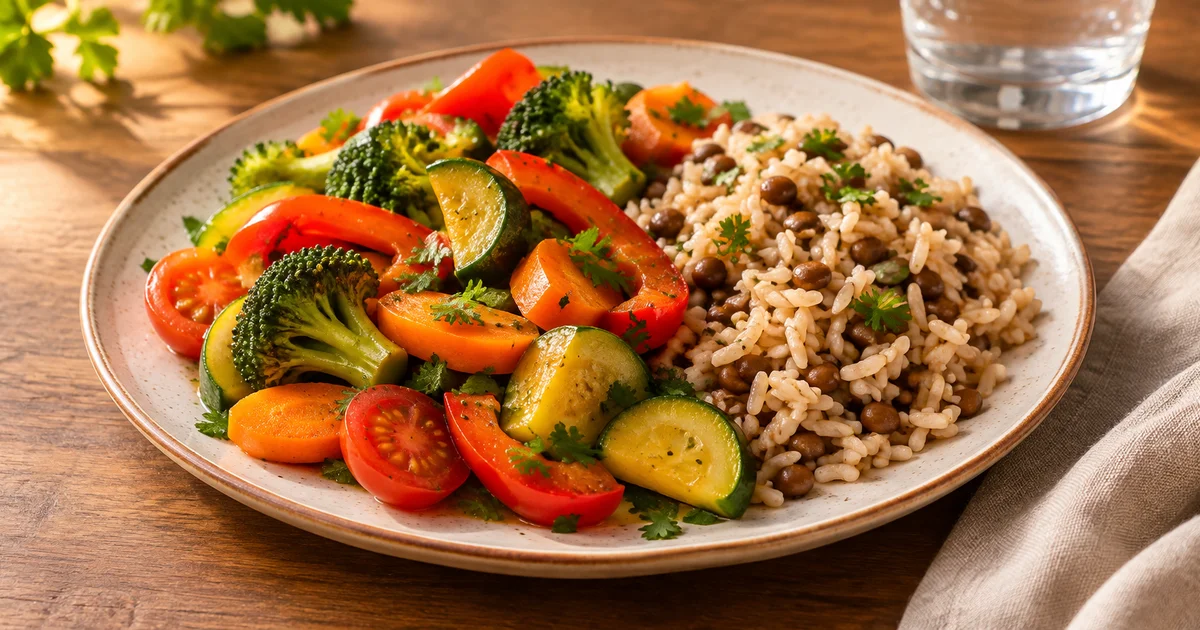
Example 2 — Vegetarian bowl: Large base of roasted mixed vegetables (half bowl), portion of cooked lentils and brown rice combined (half bowl), tahini dressing. Protein (legumes) and grains in the second half; vegetables dominate.
Example 3 — Pasta dish: Whole-grain pasta (quarter of total volume), marinara sauce with added spinach, zucchini, and mushrooms (half of total volume), Italian sausage (quarter of total volume). The dish is reworked to give vegetable content the dominant share.
5. Adapting the Framework to Different Cuisines and Budgets
The balanced plate framework is not culture-specific. It can be applied to any cuisine by assessing the same proportions in that context.
East and Southeast Asian cuisines. A large bowl of steamed rice or noodles served with a small amount of protein and minimal vegetables does not follow the framework. The same meal with a large side of stir-fried greens or a vegetable-dominant soup brings it closer. The portion of rice or noodles can remain consistent; the adjustment is in the vegetable accompaniment.
South Asian cuisines. Dal, vegetable curries, and legume-based dishes are naturally aligned with the framework. Where the framework is harder to apply is when the protein/sauce component is served over a large base of white rice without a vegetable side. Adding a vegetable preparation — a simple side salad, a lightly cooked green vegetable, raita with added vegetables — corrects this.
Budget-conscious eating. Frozen vegetables, canned legumes, and dried lentils and beans are the most affordable path to meeting the framework’s proportional recommendations. The highest-cost components of a balanced plate are typically fresh proteins (fish, meat); legumes and eggs serve the same role at substantially lower cost.
6. What Gets in the Way — and Simple Fixes
Habit and preference. Most people eat the meals they grew up with or the ones they have always prepared. The plate model asks for a re-proportioning that may feel unfamiliar — particularly the half-plate vegetable allocation, which exceeds the vegetable portion in many common meals. The fix is incremental: start by adding one additional vegetable component to meals you already cook, before changing the protein or grain components.
Cooking time. The framework does not require more cooking time — it requires different cooking priorities. Roasting a large tray of vegetables is faster and more hands-off than pan-cooking a complicated protein preparation. Having batch-cooked components ready to assemble reduces preparation to plating. For how to prepare components in advance, Batch Cooking Basics: Saving Time While Eating Well covers the mechanics of a weekly prep session.
Eating out. Restaurant meals rarely come proportioned this way. The most practical adjustment when eating out is to order a vegetable side dish and treat the meal’s default portions as a starting point rather than a finishing point — not eating a portion that exceeds appetite just because it arrived on the plate.
7. Keep Reading
This article covers what goes on the plate. For the broader structure of a weekly eating routine — including how to plan meals in advance, build a consistent shopping habit, and develop a sustainable food preparation routine — see How to Build a Sustainable Meal Planning Habit.
For guidance on maintaining this kind of eating pattern when schedules shift and consistency becomes harder, How to Maintain Healthy Eating Habits When Life Gets Busy covers the practical and behavioral factors that support or undermine eating well over time.
8. Frequently Asked Questions
Does protein have to be animal-based for a balanced plate?
No. Legumes (chickpeas, lentils, black beans, kidney beans), tofu, tempeh, edamame, eggs, and dairy all provide complete or near-complete protein and fit the protein quarter-plate allocation. A plant-based diet built around legumes, whole grains, and a variety of vegetables can follow the balanced plate framework as effectively as an omnivorous one. Combining legumes with whole grains in the same meal (e.g. rice and lentils) covers the essential amino acid profile without requiring any animal protein.
Is the balanced plate model the same as the MyPlate or Harvard Healthy Eating Plate?
The proportions described in this article are drawn from and consistent with these well-known plate models. The Harvard Healthy Eating Plate and USDA MyPlate both recommend a large vegetable allocation, whole grains in preference to refined grains, and protein as a quarter-plate component — the same shared principle this article describes. Specific allocations differ slightly between models; for instance, Harvard’s model combines vegetables and fruits in the larger half, and both models describe healthy oils and fats differently. This article describes the shared evidence-based principle across those frameworks, not a single proprietary system.
Does the framework apply to every meal, including breakfast?
The plate model is most naturally applied to main meals (lunch and dinner). Breakfast in many cultural contexts is structured differently — toast, oatmeal, eggs — and does not map as cleanly to the plate proportions. The more useful question for breakfast is whether it includes protein and fiber, which together support satiety and stabilize blood glucose across the morning. A breakfast of eggs, whole-grain toast, and fruit, or oatmeal with nuts and berries, follows the spirit of the framework without requiring a plate-proportion check.
How strictly should I follow these proportions?
The proportions are guidance, not a prescription. Eating according to this framework on most occasions matters more than precise compliance at every meal. Meals that deviate — a large pasta dish, a takeaway, a celebration meal — have minimal effect on overall dietary pattern when the surrounding days follow the framework broadly. The goal is a consistent average over time, not perfection at each sitting.
References
- Aune, D., et al. (2017). Fruit and vegetable intake and the risk of cardiovascular disease, total cancer and all-cause mortality — a systematic review and dose-response meta-analysis of prospective studies. BMJ, 356, i6583. https://pubmed.ncbi.nlm.nih.gov/28701695/
- Harvard T.H. Chan School of Public Health. (n.d.). The Healthy Eating Plate. The Nutrition Source. https://www.hsph.harvard.edu/nutritionsource/healthy-eating-plate/
- Reynolds, A., et al. (2019). Carbohydrate quality and human health: a series of systematic reviews and meta-analyses. The Lancet, 393(10170), 434–445. https://pubmed.ncbi.nlm.nih.gov/30638909/
This article was drafted with AI assistance and reviewed and approved by The Psychanatomy Editorial Team before publication.

