

Supporting Article (W1-S4-A3 · 3 of 7) | Batch Cooking Basics: Saving Time While Eating Well
Batch cooking means preparing food in advance — ingredients, components, or complete meals — so that the daily effort of eating well is spread across fewer cooking sessions. For people who have limited time on weekday evenings but want to eat home-cooked food consistently, batch cooking is one of the most practical tools available. This article is a companion to How to Build a Sustainable Meal Planning Habit, which covers the broader planning process; this article focuses specifically on how to implement the preparation stage.
1. What This Article Covers
This article explains what batch cooking involves, what the evidence says about cooking at home and dietary outcomes, what foods are best suited to advance preparation, and how to handle batch-cooked food safely. It includes practical examples throughout and covers how to start if you have no current prep routine.
It does not prescribe a specific dietary framework or tell you what to eat. The focus is on the mechanics of advance preparation — how to do it efficiently, safely, and in a way that reduces rather than adds to the weekly workload.
2. What Batch Cooking Involves
Batch cooking is not a single technique — it is a category that includes several different approaches, all aimed at reducing the number of times you start from scratch during the week.
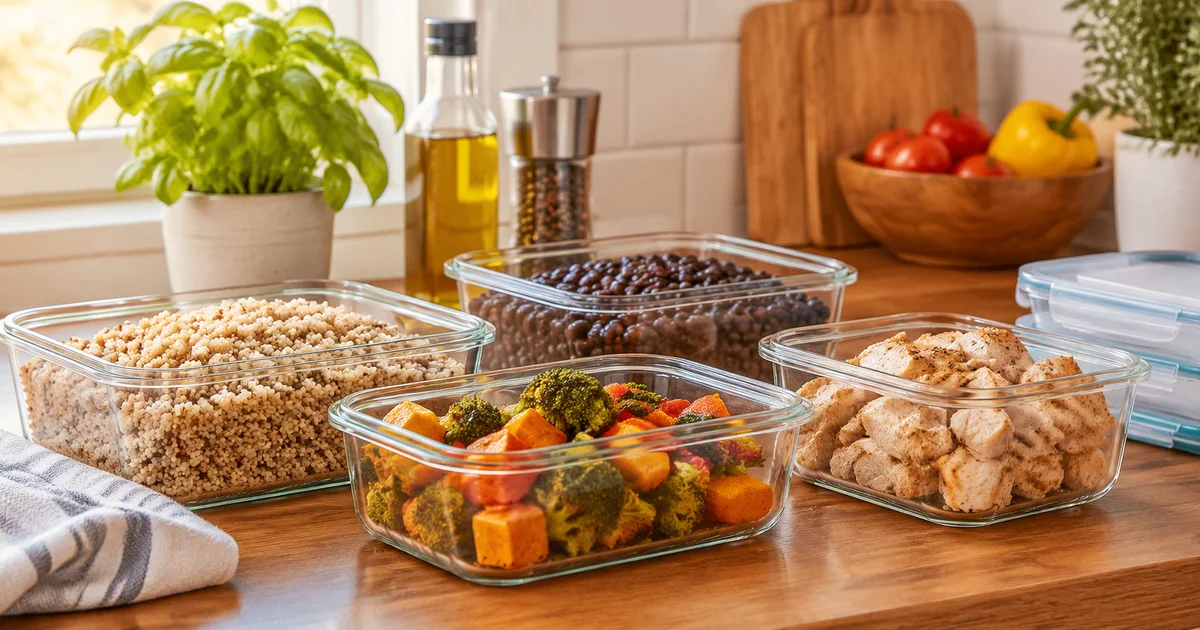
Component-based batching. This is the most flexible approach. You cook base ingredients — a large pot of grains, a tray of roasted vegetables, a batch of hard-boiled eggs, cooked pulses — without assembling them into specific dishes. These components can be combined in different ways throughout the week: grains with vegetables and protein one evening, the same grains in a different combination the next. This avoids eating the same meal repeatedly while still benefiting from advance prep.
Full-meal batching. You cook two or three complete dishes in one session and store them in portions. Soups, stews, curries, grain dishes, and pasta bakes all reheat reliably. This requires less weeknight assembly than component batching but less flexibility — if you do not want to eat the same dish twice that week, you need to plan enough variety upfront.
Ingredient-only batching. You prepare but do not cook: washing and chopping vegetables, marinating proteins, measuring dry ingredients. This reduces evening cooking time without fully committing to finished dishes. It suits people who prefer the sensory experience of cooking fresh but do not have the time to do full prep on weeknights.
Most households benefit from a combination: a few components cooked through the weekend, one or two full dishes ready to reheat, and some fresh prep to keep meals feeling varied.
3. What the Research Shows
People who cook at home more frequently tend to have higher vegetable consumption and better overall dietary quality. A cross-sectional analysis of NHANES 2007–2010 data among SNAP participants found that those who cooked dinner at home more than six times per week consumed substantially more vegetables than those who cooked fewer than twice per week (Wolfson & Bleich, 2015). Batch cooking matters in this context because it is a mechanism for increasing home-cooked meal frequency: a person who would otherwise get three weeknight dinners cooked at home may reliably get five or six when a batch session on the weekend does most of the work.
Separately, meal planning itself — which batch cooking supports — is associated with higher diet quality and greater food variety. A large cross-sectional study of French adults found that meal planning was associated with higher diet quality, greater dietary variety, and lower odds of overweight and obesity (Ducrot et al., 2017). The practical implication is that the planning and preparation stages reinforce each other: advance cooking makes planned meals easier to execute, and planning makes advance cooking more purposeful.
4. Food Safety: What Changes When You Cook in Advance
Batch cooking introduces food safety considerations that do not arise when cooking and eating immediately. The core principle is controlling temperature: bacteria multiply rapidly in cooked food held between 40°F and 140°F (4°C and 60°C) — the temperature danger zone. Keeping cooked food outside this range, for as short a time as possible, is what prevents foodborne illness.
After cooking. Cooked food should be moved into refrigeration within two hours of finishing cooking, or within one hour if the room temperature is above 90°F (32°C). Do not let a large pot cool slowly on the counter — divide it into smaller shallow containers so it cools faster before refrigerating. Stacking warm food in a closed container delays cooling and extends the time the food spends in the danger zone.
Refrigerator storage. A refrigerator should be maintained at 40°F (4°C) or below. At this temperature, most cooked foods remain safe for 3 to 4 days. This is a firm guideline, not a rough estimate — cooked rice, cooked meats, cooked legumes, and cooked vegetables all follow this rule. If you are not confident a dish will be used within that window, freeze it rather than storing it in the refrigerator.
Freezer storage. Cooked food kept at 0°F (−18°C) is safe indefinitely from a food safety perspective, though quality degrades over time. Most cooked meals maintain acceptable quality for two to three months in the freezer. Use airtight containers or freezer bags, label with the date, and rotate so older items are used first.
Reheating. Reheated food should reach an internal temperature of 165°F (74°C) throughout before eating. A food thermometer is the most reliable way to verify this, particularly for dense dishes like casseroles or thick soups where the edges may heat faster than the center. Microwave reheating heats unevenly — stirring midway and verifying temperature helps.
What batches well and what does not. Grains, legumes, roasted or sautéed vegetables, soups, stews, curries, and egg-based dishes (frittatas, hard-boiled eggs) all hold well in refrigeration and reheat reliably. Leafy greens, raw tomatoes, cucumber, and other high-moisture salad vegetables do not hold well once dressed and are better kept separate and assembled at the time of eating. Pasta holds reasonably well but is better stored separately from its sauce if kept more than a day.
These guidelines are drawn from USDA FSIS food safety standards (USDA FSIS, 2024).
5. How to Structure a Batch Cooking Session
A productive batch session does not have to take a full day. Most people can prepare enough food for three to five weeknight meals in 60 to 90 minutes, once a routine is established.
Decide before you start. The session is more efficient when you know in advance what you are cooking. A list of two or three components and one or two full dishes is a reasonable scope. It is better to complete a modest plan than to start ambitiously and have something go wrong partway through.
Use the oven and stovetop simultaneously. While something roasts in the oven (a tray of vegetables, a whole chicken, a tray of chickpeas), something else can cook on the stovetop (a pot of grains, a simmering soup). This cuts elapsed time substantially without requiring more active attention per item.
Cool and portion before refrigerating. Divide cooked items into single-serving or two-serving containers immediately after cooling, rather than storing in one large batch and scooping from it throughout the week. Pre-portioned containers make choosing and reheating faster — the decision about what to eat has already been made.
Three practical examples:
Example 1 — Grain bowl components (45 minutes): Cook a pot of brown rice or quinoa; roast two trays of mixed vegetables with olive oil and seasoning; cook a batch of lentils from dried. These three components combine into varied grain bowls all week.
Example 2 — Full-meal batch (75 minutes): Prepare a large pot of chicken and vegetable soup; cook a tray of hard-boiled eggs; make a simple bean stew. The soup provides two to three dinners; the eggs and beans add flexible protein and lunch options.
Example 3 — Ingredient prep only (30 minutes): Wash and chop all vegetables for the week; marinate proteins in separate bags; cook one pot of grains. No complete meals, but weeknight cooking time is significantly reduced.
6. What Gets in the Way — and How to Work Around It
Not knowing what to cook. A batch session without a plan often leads to the wrong mix — too much of one thing, components that do not combine well, missing a protein or a vegetable. The fix is to plan the session from the week’s planned meals, not independently of them. For guidance on grocery shopping to stock a kitchen before the batch session, see Grocery Shopping for Balanced Nutrition: A Practical Guide.
Running out of storage containers. Glass containers with airtight lids are the most practical solution for refrigerator storage and direct reheating. Having enough containers for the entire week’s batch before starting the session prevents compromises on portioning or cooling time. This is a one-time equipment purchase that simplifies every subsequent session.
Fatigue with repeated meals. Component-based batching largely solves this: the same set of cooked ingredients tastes different depending on how they are seasoned, combined, and paired. Keeping sauces and seasonings separate until serving extends variety considerably. If you batch one or two complete dishes, planning for them to be used at defined points in the week (not every day) also helps.
Inconsistent timing. A batch session done at the same point each week — Sunday morning, Saturday afternoon — builds into a predictable routine faster than one done whenever time allows. Even 45 minutes of consistent, deliberate prep is more valuable than a larger, irregular session.
7. Keep Reading
This article covers batch cooking as a practical mechanism for reducing weeknight effort. For the broader planning framework that this preparation stage fits into — including how to review the week ahead, choose what to cook, and build a sustainable planning habit — see How to Build a Sustainable Meal Planning Habit.
For guidance on how to use what you batch cook within a nutritionally varied daily structure, Building a Balanced Plate: A Visual Framework covers how to think about the components of a nutritionally complete meal.
8. Frequently Asked Questions
How much time does a typical batch cooking session take?
For most households, a session preparing enough food for three to five weeknight meals takes 60 to 90 minutes once the routine is established. The first few sessions may take longer as you develop an efficient flow — deciding what to cook simultaneously, managing oven and stovetop together, and setting up containers in advance. After a few repetitions, the process becomes much faster. A minimal session of 30 to 45 minutes (cooking one pot of grains and doing ingredient prep only) is a reasonable starting point for anyone new to batch prep.
Can I freeze batch-cooked meals for later in the week or the following week?
Yes. Most cooked dishes — soups, stews, curries, cooked grains, cooked legumes, egg-based dishes — freeze well. Cooked food stored at 0°F (−18°C) is food-safe indefinitely, though quality is best within two to three months. For the upcoming week’s meals, refrigerator storage (3–4 days maximum) is sufficient. For longer storage or cooking in larger quantities less frequently, freezing is reliable. Label containers with the date so you can rotate and use older items first.
Does batch-cooked food lose nutritional value compared with freshly cooked food?
The nutritional impact of cooking and storing food is real but modest for most practical batch cooking. Some water-soluble vitamins (vitamin C, some B vitamins) degrade during cooking and again during reheating. This is not a reason to avoid batch cooking — for many people, the realistic alternative is not fresh daily cooking but convenience foods or skipped meals, neither of which offers the same nutritional profile as a home-cooked batch meal. Batch cooking vegetables, legumes, and whole grains and eating them within 3 to 4 days preserves most of their nutritional content.
Is it safe to batch cook rice and store it?
Cooked rice requires careful handling because Bacillus cereus spores can survive cooking and produce toxins if rice is left at room temperature. The key is to cool rice rapidly and refrigerate it within two hours of cooking. Cooked rice stored at 40°F (4°C) or below is safe for 3 to 4 days. Never leave cooked rice at room temperature for extended periods, and reheat it to 165°F (74°C) internal temperature before eating.
References
- Wolfson, J. A., & Bleich, S. N. (2015). Fruit and vegetable consumption and food values: differences among adults who do and do not cook at home. Preventive Medicine, 76, 1–7. https://pubmed.ncbi.nlm.nih.gov/25847732/
- Ducrot, P., et al. (2017). Meal planning is associated with food variety, diet quality and body weight status in a large sample of French adults. International Journal of Behavioral Nutrition and Physical Activity, 14(1), 12. https://pubmed.ncbi.nlm.nih.gov/28153017/
- U.S. Department of Agriculture Food Safety and Inspection Service (USDA FSIS). (2024). Leftovers and Food Safety. https://www.fsis.usda.gov/food-safety/safe-food-handling-and-preparation/food-safety-basics/leftovers-and-food-safety
This article was drafted with AI assistance and reviewed and approved by The Psychanatomy Editorial Team before publication.

