

Supporting Article (WB1-S5-A3 · 3 of 8) | WB2 — Academic Exploitation
1. What This Article Covers
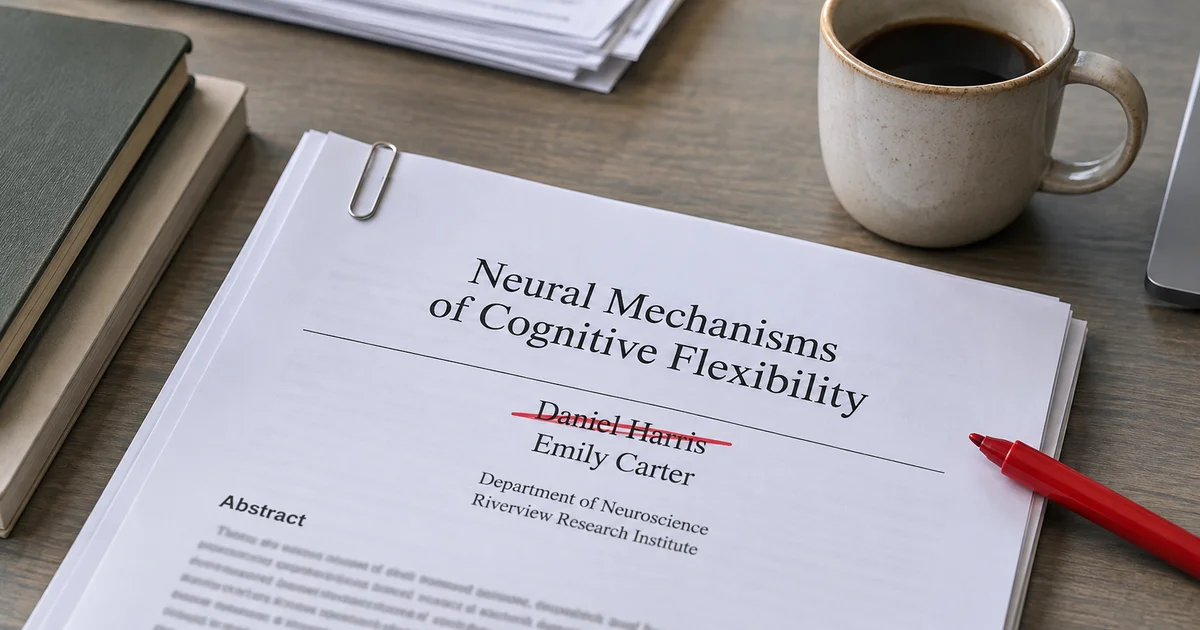
Authorship weaponization is the deliberate use of publication credit — authorship inclusion, exclusion, ordering, or the implicit threat of any of these — as a mechanism to enforce compliance, extract labor, or punish dissent in a doctoral or postdoctoral supervisory relationship.
This article covers authorship specifically as a coercive instrument. It does not cover funding control, reference letter leverage, or the broader framework of academic exploitation; for the full picture of how supervisory authority operates across all of these mechanisms simultaneously, see Academic Exploitation: How Supervisors Use Research Authority to Control Doctoral Students and Postdoctoral Researchers.
2. Why Authorship Is a Particularly Effective Lever
Publication credit is the primary currency of academic career progression. For a doctoral student or postdoc, authorship — specifically first authorship — determines their eligibility for independent funding, faculty positions, and research portfolios that make the years of training legible to future employers. This is not merely professional preference; it is a structural fact of how academic careers are assessed. A supervisor who controls authorship decisions controls the most consequential output of a researcher’s most professionally vulnerable years.
What makes authorship weaponization distinct from other forms of academic coercion is its near-total informality. There are no payslips and no HR records; authorship contributions are not formally documented in most research environments. Decisions about who is named, in what order, and on which paper rest almost entirely on the supervisor’s discretion — and are rarely reviewed by anyone with the authority or interest to intervene.
Research on doctoral student mental health consistently documents that supervisory relationship quality is among the strongest predictors of anxiety, depression, and mental health impairment in PhD students (Levecque et al., 2017; Evans et al., 2018). Coercive control mechanisms — the systematic use of power to constrain another person’s autonomy — are associated with significant psychological and trauma impacts when sustained over time (Lohmann et al., 2024). Authorship weaponization functions as one such mechanism within the specific structure of academic supervision, where the target’s ability to leave is constrained by sunk costs, immigration status, and career dependency simultaneously.
3. The Forms Authorship Weaponization Takes
Authorship weaponization appears in several distinct patterns:
Withholding or demoting authorship as punishment. A researcher who raises concerns, sets limits, or fails to comply with demands unrelated to the research may find their expected authorship on a paper delayed, downgraded from first to middle author, or removed — with an explanation framed in research-performance terms.
Conditional authorship as compliance incentive. Authorship inclusion, or first-author position, is implicitly or explicitly promised in exchange for compliance with demands — excessive hours, lab tasks outside the student’s project, personal assistance, or silence about supervisory misconduct.
Ghost authorship. A researcher does the substantive intellectual and empirical work of a paper; the supervisor takes first authorship, frames this as the standard supervisory contribution, and the researcher receives middle-author or no credit. This is not uncommon as a cultural practice in some research environments, which is precisely what makes it difficult to name as coercion: normalization functions as cover.
Gift authorship as social leverage. A supervisor may add favored collaborators or students to authorship lists as gifts, devaluing the list while demonstrating that authorship decisions rest entirely on their discretion.
4. What Makes Authorship Coercion Difficult to Document
The absence of formal authorship records is both the mechanism’s greatest enabler and the researcher’s greatest obstacle. Research integrity frameworks — including ICMJE guidelines and institutional policies — define authorship criteria clearly: substantial contribution to conception, design, data acquisition, or analysis; drafting or critical revision; accountability for the work. These criteria are rarely applied prospectively in a supervisory relationship, and rarely enforced after the fact unless a formal complaint reaches a journal or research integrity office.
A researcher who believes their authorship was manipulated must therefore mount a formal complaint about a decision that was never formally documented, against a person with direct authority over their career.
Keeping a dated record of your contributions to each paper — meetings, drafts, data-analysis responsibilities, writing contributions — before authorship decisions are formalized provides materially better standing in any formal process than a retrospective account. Research integrity offices can also be consulted confidentially before a formal complaint is filed.
5. Practical Steps
Learn your institution’s authorship policy. Most research institutions have formal authorship policies that define contribution criteria. Many also have research integrity officers who can discuss authorship concerns confidentially before you decide whether to formalize anything. Knowing what policy exists and who enforces it changes your starting position.
Document contributions contemporaneously. For every project you contribute to significantly, keep a private record — dated, specific, with enough detail to establish what you contributed and when. Email correspondence confirming your role in a project is especially useful: it creates a contemporaneous record that neither party can easily contest.
Understand what a formal process involves before you decide. Research integrity offices have formal procedures for authorship disputes. Understanding what a process requires, what it can achieve, and what risks it carries before committing to it is not defeatism; it is effective planning. An ombudsperson or faculty member outside your supervisory line can provide a confidential independent read before you act.
6. Where This Fits Into the Bigger Picture
Authorship weaponization is one of several coercive mechanisms covered in Academic Exploitation: How Supervisors Use Research Authority to Control Doctoral Students and Postdoctoral Researchers, which provides the full framework for understanding how research authority converts to personal control across a doctoral or postdoctoral career. For the wider view across this entire topic, narcissistic exploitation in professional life: how authority over career and livelihood is weaponized covers the full picture beyond just this silo.
If you are navigating a situation involving multiple overlapping forms of leverage — funding, authorship, and recommendation letters simultaneously — Reference Letter Control: How Supervisors Restrict Career Options Through Recommendation Authority covers the third major mechanism directly.
Funding control is often what enables a supervisor to make authorship threats credible — the researcher cannot leave. For that dynamic, see Funding Control as Leverage: How Supervisors Manage Stipends and Grant Access.
7. Frequently Asked Questions
Is authorship manipulation against research ethics guidelines?
Yes. International authorship guidelines — including the ICMJE criteria, which are widely adopted by journals across fields — require that authorship be based on documented contribution, not on seniority, lab hierarchy, or compliance with demands unrelated to the research. Ghost authorship (substantial contributor not credited) and gift authorship (non-contributor credited) are both defined as research integrity violations in most institutional policies. The practical enforcement of these guidelines is inconsistent, but the normative standard is clear.
What counts as a substantial contribution to authorship?
The ICMJE criteria, which are the dominant standard in biomedical and social science research, require all four of: substantial contribution to conception/design or data acquisition/analysis; drafting or critically revising the work; final approval of the version to be published; and agreement to be accountable for the work’s integrity. Meeting only one criterion — for example, data collection alone, or writing alone — does not meet the standard. Many disputes arise because contribution boundaries were never agreed upon in advance.
Can I report authorship coercion without filing a formal complaint?
Yes. Most institutions have research integrity officers and ombudspersons who provide confidential consultations. These conversations do not initiate a formal investigation; they help you understand your options, the evidence standards that would apply, and what institutional processes are available. This is usually the right first step before deciding whether to formalize anything.
Does changing supervisor mean losing authorship on work I contributed to?
This depends on the institution, the journal, and the specific contribution. Authorship on a paper already submitted or in revision is governed by the journal’s policies and the institution’s research integrity framework — a supervisor cannot unilaterally remove an author from a submitted manuscript without process. Authorship on work in progress is more vulnerable. Research integrity offices can advise on what protections exist for your specific situation before you make a decision.
References
- Evans, T. M., Bira, L., Gastelum, J. B., Weiss, L. T., & Vanderford, N. L. (2018). Evidence for a mental health crisis in graduate education. Nature Biotechnology, 36(3), 282–284.
- Levecque, K., Anseel, F., De Beuckelaer, A., Van der Heyden, J., & Gisle, L. (2017). Work organization and mental health problems in PhD students. Research Policy, 46(4), 868–879.
- Lohmann S, Legge SE, Owen-Smith A, John A, Dua D, Walters H, Stickley A, Kerr M, Brookes-Howell L (2024). The Trauma and Mental Health Impacts of Coercive Control: A Systematic Review and Meta-Analysis. Trauma, Violence, & Abuse, 25(3), 1839–1854.
This article was drafted with AI assistance and reviewed and approved by Dr. Imad Alkamal before publication.

