

Supporting Article (W1-S4-A6 · 6 of 7) | Cooking Methods and Nutrient Retention: What Changes and What Doesn’t
Cooking changes food in ways that affect nutrient content — sometimes reducing it, sometimes increasing it. For people trying to eat a nutritionally consistent diet, understanding which cooking methods preserve or improve nutritional value helps inform practical decisions in the kitchen. This article is a companion to How to Build a Sustainable Meal Planning Habit, which covers the broader planning and preparation framework; this article focuses specifically on the nutritional implications of how food is cooked.
1. What This Article Covers
This article explains how different cooking methods affect specific categories of nutrients — particularly water-soluble vitamins, carotenoids, and minerals — and what practical decisions follow from that evidence.
It does not prescribe a single optimal cooking method for all foods. The relationship between cooking and nutritional value is nutrient-specific and varies by food, cooking duration, and temperature. The goal is to give accurate, non-absolutist guidance that helps people make informed cooking choices rather than abandoning methods that are still nutritionally sound.
2. Why Cooking Affects Nutrient Content
Heat, water, and time are the variables that determine how much of a food’s nutritional content changes during cooking. The mechanisms differ depending on the type of nutrient involved.
Water-soluble nutrients leach into cooking liquid. Vitamins C and folate (vitamin B9), along with other B vitamins, dissolve readily in water. When food is submerged in boiling water, these nutrients migrate out of the food and into the surrounding liquid. If that liquid is drained and discarded — as it typically is after boiling vegetables — a significant portion of these vitamins is lost with it. The longer the cooking time and the more water involved, the greater the leaching.
Heat degrades certain vitamins. Vitamin C is both water-soluble and heat-sensitive. Prolonged exposure to high temperatures accelerates its breakdown regardless of whether water is involved. This is why microwave cooking, despite using high heat, can actually preserve more vitamin C than boiling: the total cooking time is much shorter, reducing cumulative heat exposure.
Heat can liberate and enhance other nutrients. Plant cells have rigid walls that physically contain compounds including carotenoids (the pigments responsible for orange, red, and yellow colors in vegetables). Cooking softens and disrupts these cell walls, releasing carotenoids in a form that is more accessible during digestion. This is why cooked carrots or cooked tomatoes can deliver more absorbable beta-carotene or lycopene than the same vegetables eaten raw, even though some other nutrients are reduced by cooking.
Minerals are more heat-stable. Potassium, magnesium, iron, and other minerals do not degrade with heat in the way vitamins do. They can still leach into cooking water, but their structural stability means cooking method matters less for mineral retention than it does for vitamins.
3. How Cooking Methods Compare
The table below summarizes the evidence on how common home cooking methods affect key nutrient categories in vegetables.
| Cooking method | Water-soluble vitamins (C, folate) | Carotenoids | Minerals | Notes |
|---|---|---|---|---|
| Boiling | Highest losses — leaching + heat | Moderate losses | Some leaching | Losses depend on time and water volume; using cooking water in a sauce/soup recovers some |
| Steaming | Good retention — no submersion, shorter time | Moderate losses | Low leaching | Most consistent method for preserving water-soluble vitamins |
| Microwaving | Good retention — short duration | Moderate losses | Low leaching | Comparable to steaming; speed limits heat exposure |
| Stir-frying | Moderate losses — high heat, short time | May enhance bioaccessibility (fat present) | Low leaching | Speed and minimal water make it reasonably nutrient-preserving |
| Roasting/baking | Moderate-high losses from sustained dry heat | May enhance bioaccessibility | Low leaching | Good for dense root vegetables; longer cooking times reduce water-soluble vitamins |
| Pressure cooking | Moderate losses — shorter time than boiling, still submerged | Moderate losses | Some leaching | Faster than boiling; comparable or slightly better overall |
What this table does not say: it does not say any of these methods produces nutritionally poor food, or that raw is always better. All of these methods are compatible with a nutritionally adequate diet. The differences matter at the margin and over time — a person who steams vegetables rather than boiling them will consistently retain more vitamin C, but the nutritional contribution of a boiled vegetable is still substantially positive.
The evidence on these patterns comes from a review of cooking methods and their effects on nutritional quality in vegetables, potatoes, and pulses, which found that methods involving prolonged water exposure at high temperature were most detrimental to water-soluble nutrients, while steaming and microwaving generally preserved higher proportions (Coe & Spiro, 2022).
4. Carotenoids: Where Cooking Helps
The carotenoid story is worth explaining separately because it runs counter to the intuition that raw food is always more nutritious.
Carotenoids — including beta-carotene (in carrots, sweet potato, and leafy greens), lycopene (in tomatoes), and lutein (in spinach and kale) — are fat-soluble compounds embedded within the cell matrix of plant foods. In raw vegetables, the physical structure of this matrix limits how much of the carotenoid is available for absorption. Cooking breaks down the cell walls that contain them.
A review of cooking’s effects on phytochemical content across more than 100 studies found that while cooking reduces many phenols and glucosinolates (other beneficial plant compounds), carotenoids respond differently — heat treatment was associated with enhanced extraction and increased bioaccessibility compared with the raw food, particularly for carrots and tomatoes (Palermo et al., 2014).
Fat matters for carotenoid absorption. Because carotenoids are fat-soluble, their absorption from the digestive tract requires the presence of dietary fat. A meal containing carotenoid-rich vegetables with no fat source — olive oil, avocado, nuts, or a fat-containing protein — absorbs substantially less of the available carotenoid than the same meal with fat present. Dressing a salad, roasting with olive oil, or adding seeds to a vegetable dish is not just for flavour; it is a meaningful contributor to how much of the carotenoid content is actually absorbed.
Practical implication: cooking tomatoes, carrots, sweet potato, and leafy greens increases the amount of carotenoid the body can access. Eating these foods raw is still nutritionally positive, but cooking does not reduce their carotenoid value — in this case, it increases it.
5. What This Means for Real Cooking Decisions
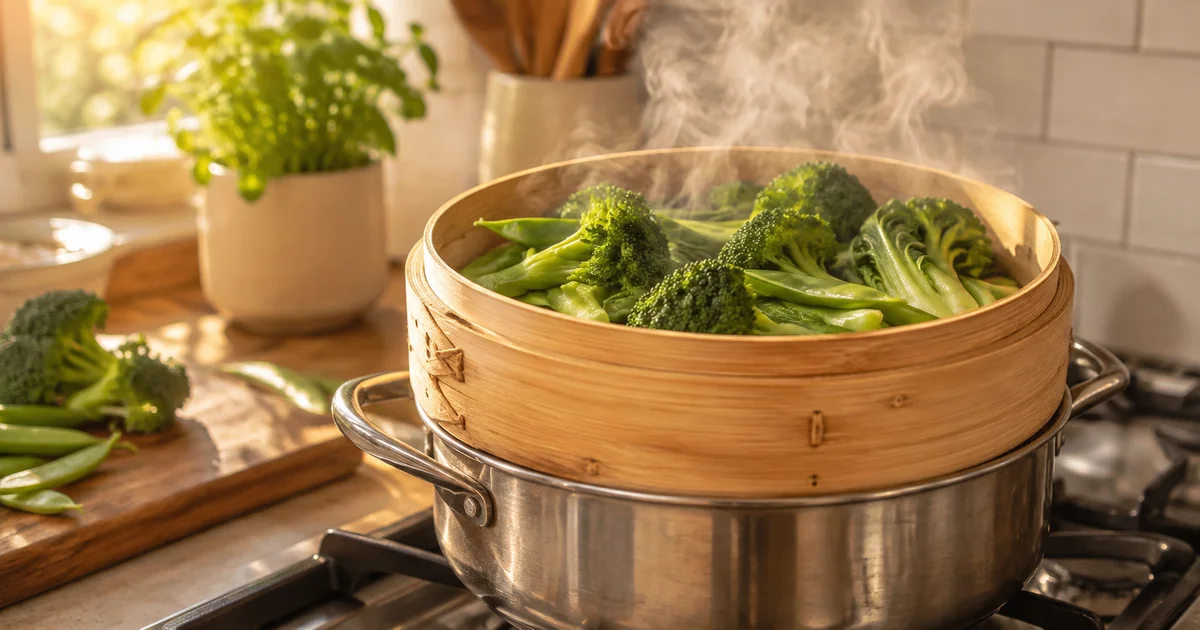
Prefer steaming or microwaving for cruciferous and leafy vegetables. Broccoli, spinach, kale, peas, and other high-vitamin-C vegetables benefit most from cooking methods that minimize leaching. Steaming or microwaving for a short time is the most practical way to deliver consistently higher vitamin retention for these foods.
Boiling is still acceptable — especially when you use the cooking water. The practical argument against boiling is leaching. That argument weakens considerably if the cooking water is used in the same dish — as a base for soup, reduced into a pan sauce, or added to a stew. The nutrients that leached out are still present in the liquid. Discarding cooking water after boiling is where the loss actually occurs, not boiling itself.
Cook tomatoes and orange-yellow vegetables with a fat source. This is one of the most direct applications of the carotenoid evidence. Roasted carrots with olive oil, tomato sauce with olive oil, or sweet potato roasted in avocado oil are practical ways to maximize carotenoid absorption. This is not about eliminating raw versions — a fresh tomato salad with olive oil dressing is similarly effective — but about ensuring fat is present when eating carotenoid-dense foods.
Shorter cooking times generally preserve more. For every cooking method, the relationship between time and nutrient loss runs in the same direction: more time means more loss, particularly for heat-sensitive vitamins. Cooking to the point of tenderness rather than softness preserves both texture and nutrition. Overcooked vegetables lose both.
Color retention is a rough guide. A vegetable that retains its vibrant color through cooking has generally been cooked at a temperature and duration that also preserves more of its nutritional content. A dull or heavily softened vegetable has been cooked past the point where this holds.
6. What Gets in the Way — and Simple Adjustments
Boiling from habit without reconsidering. Most people learn to cook vegetables by boiling them, and the habit persists. The practical adjustment is not to stop boiling but to either switch to steaming for high-vitamin-C vegetables or start using the cooking water in the dish rather than discarding it.
Assuming raw is always best. For water-soluble vitamins, raw does preserve them. For carotenoids, raw may deliver less than cooked. The more accurate position is that neither raw nor cooked is universally superior — the question is which nutrients you are optimizing for in which food. Variety across both is a reasonable approach that sidesteps the question entirely.
Long slow cooking without regard for time. Slow cookers and low-and-slow methods involve extended heat exposure. For nutrient retention, the advantage is that cooking liquid is usually consumed as part of the dish, recovering any leached minerals and water-soluble vitamins. The disadvantage is long heat exposure, which degrades heat-sensitive vitamins. For dishes where the cooking liquid is consumed, slow cooking’s overall nutritional profile is not as poor as a focus on leaching alone would suggest.
Microwave anxiety. Microwave cooking consistently performs well for nutrient retention because cooking times are short, water use is minimal, and the food is not submerged. There is no evidence-based nutritional reason to avoid microwaving vegetables. It is one of the best methods available for preserving water-soluble vitamins.
7. Keep Reading
This article covers how cooking method affects nutritional value. For the broader challenge of maintaining food habits consistently across busy periods — including the environmental and behavioral factors that support or disrupt eating well — How to Maintain Healthy Eating Habits When Life Gets Busy covers what actually helps when routine breaks down.
8. Frequently Asked Questions
Does cooking destroy most of the nutrients in vegetables?
No. The impact of cooking on nutrient content is real but partial — substantial amounts of most nutrients survive even after boiling. Studies show meaningful losses of water-soluble vitamins like vitamin C under extended boiling, but the cooked vegetable still contains significant nutritional value. The more useful framing than “cooking destroys nutrients” is that some cooking methods are better than others for preserving specific nutrients, and that variety across both cooked and raw vegetables over the course of a week provides a wide range of nutritional benefits.
Is steaming always better than boiling?
Steaming consistently preserves higher proportions of water-soluble vitamins than boiling, because the food is not submerged in water and leaching is minimized. For most vegetables high in vitamin C or folate, steaming is preferable to boiling where practical. However, if cooking water is used in the final dish rather than discarded, the difference between steaming and boiling is substantially reduced, since leached nutrients remain in the liquid.
Why do cooked carrots and tomatoes sometimes seem more nutritious than raw?
Heat disrupts plant cell walls, releasing carotenoids — the orange, red, and yellow pigments in these vegetables — in a more bioaccessible form. In raw carrots and tomatoes, the rigid cell matrix physically limits how much beta-carotene and lycopene the digestive system can extract. Cooking opens that matrix. Eating these foods with a fat source (olive oil, avocado, nuts) further increases absorption because carotenoids are fat-soluble and require fat present in the digestive system to be taken up efficiently. For guidance on how to structure meals to include these components, see Portion Awareness: Understanding Amounts Without Obsessive Tracking.
Does microwaving reduce nutritional value?
Microwaving generally preserves nutritional value well compared with other cooking methods. The key variable for water-soluble vitamin retention is cooking time and water contact — microwave cooking is short in both, which limits heat degradation and leaching. For most vegetables, microwaving is comparable to or better than steaming for nutrient retention. The popular belief that microwaving is nutritionally damaging does not reflect the evidence.
References
- Coe, S., & Spiro, A. (2022). Cooking at home to retain nutritional quality and minimise nutrient losses: A focus on vegetables, potatoes and pulses. Nutrition Bulletin, 47(4), 538–562. https://pubmed.ncbi.nlm.nih.gov/36299246/
- Palermo, M., Pellegrini, N., & Fogliano, V. (2014). The effect of cooking on the phytochemical content of vegetables. Journal of the Science of Food and Agriculture, 94(6), 1057–1070. https://pubmed.ncbi.nlm.nih.gov/24227349/
This article was drafted with AI assistance and reviewed and approved by The Psychanatomy Editorial Team before publication.

