

Supporting Article (W1-S1-A4 · 3 of 6) | Dietary Fats Explained: Saturated, Unsaturated, and Trans Fats
1. Why Fat Classification Matters
Dietary fat is essential — your body uses it to absorb fat-soluble vitamins, produce hormones, support cell membrane structure, and provide a concentrated source of energy. But the category “dietary fat” encompasses several structurally different types of molecules that behave differently in the body and have meaningfully different associations with cardiovascular health.
Understanding the distinction between saturated, unsaturated, and trans fats is one of the most practically useful pieces of nutrition knowledge, because it allows you to make informed food choices rather than applying a blanket “fat is good” or “fat is bad” rule that the evidence simply does not support.
Fat is one of three macronutrients. For a broader picture of how it fits alongside protein and carbohydrates, see the macronutrients overview.
2. Saturated Fats: Structure and Sources
Saturated fats have carbon chains where every carbon atom is bonded to the maximum number of hydrogen atoms — they are “saturated” with hydrogen. This structural feature makes them solid at room temperature. Butter, lard, coconut oil, and the fat in beef and full-fat dairy products are predominantly saturated.
The body can synthesize saturated fat from other nutrients, and it plays genuine structural roles — it is part of cell membranes and is used in several biological processes. The health research interest in saturated fat centers on its relationship with blood lipids and cardiovascular disease.
3. Unsaturated Fats: Monounsaturated and Polyunsaturated
Unsaturated fats have one or more double bonds in their carbon chain, which creates bends in the molecule and makes these fats liquid at room temperature.
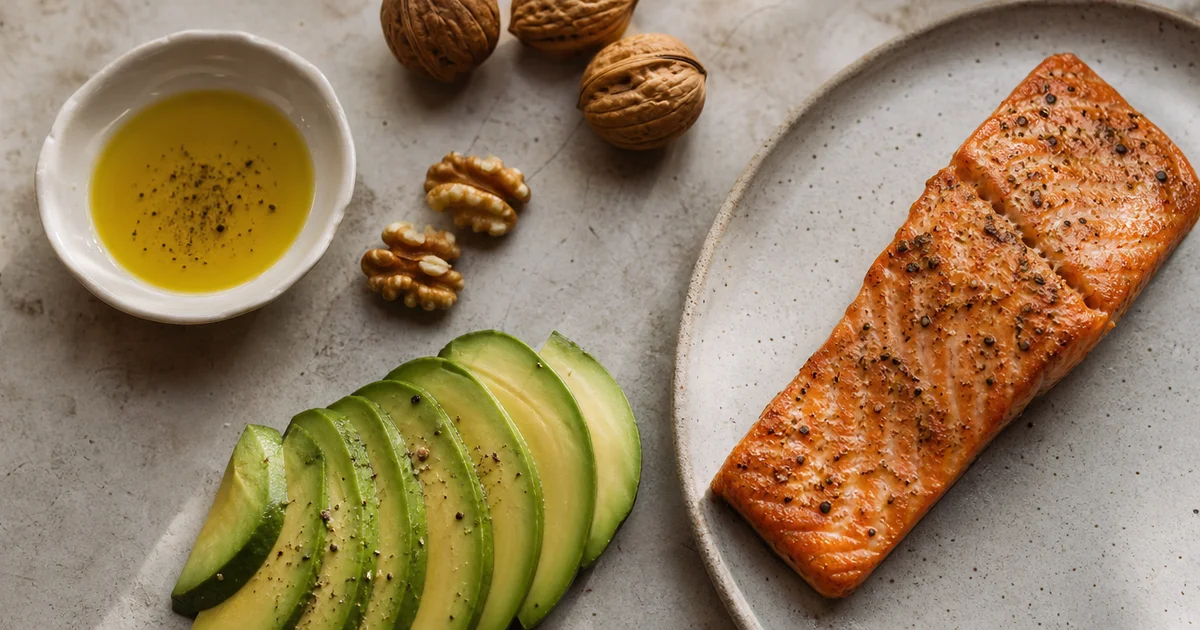
Monounsaturated fats (MUFAs) have a single double bond. Olive oil, avocado, and most nuts are rich in monounsaturated fat. These are generally considered favorable by most dietary guidelines.
Polyunsaturated fats (PUFAs) have multiple double bonds. Fatty fish, walnuts, flaxseed, sunflower oil, and soybean oil are major sources. The two main families of polyunsaturated fats — omega-3 and omega-6 — are essential fatty acids: the body cannot synthesize them and must obtain them from food.
Omega-3 fatty acids (found at high levels in fatty fish like salmon, mackerel, and sardines) have a substantial body of research supporting their role in reducing cardiovascular disease risk and systemic inflammation. Omega-6 fatty acids are found primarily in vegetable oils and processed foods.
Saturated fats (solid at room temperature; primarily from animal sources) have no double bonds in their carbon chains. Unsaturated fats (liquid at room temperature; primarily from plant foods and fish) have one or more double bonds, changing how they behave in the body. Industrial trans fats were created artificially by partially hydrogenating liquid vegetable oils and have a cardiovascular risk profile distinct from both saturated and unsaturated fats.
4. Trans Fats: Industrial Origin and Cardiovascular Concerns
Trans fats are unsaturated fats with a particular bond configuration that behaves more like saturated fat in the body. They occur naturally in small amounts in ruminant animal products (beef and lamb fat, dairy), but the primary concern has been industrially produced trans fats — created by partially hydrogenating liquid vegetable oils to make them solid, stable, and shelf-stable.
Industrial trans fats (found in margarine, shortening, and processed baked goods) have the least favorable lipid profile of any dietary fat: they raise LDL (“bad”) cholesterol, lower HDL (“good”) cholesterol, and are associated with systemic inflammation. Their cardiovascular disease association is among the most consistent findings in nutritional epidemiology.
In response to this evidence, regulatory agencies in many countries, including the US FDA, have moved to remove partially hydrogenated oils from the food supply. Industrial trans fat content in the typical Western diet has declined substantially over the past two decades.
5. What the Research Shows
The research on dietary fat and cardiovascular health is more nuanced than simplified “saturated fat is bad, unsaturated fat is good” messaging suggests.
Large meta-analyses of prospective cohort studies have found that replacing saturated fat with polyunsaturated fat is consistently associated with reduced cardiovascular disease risk. The relationship between saturated fat and cardiovascular disease is real and well-documented — but the picture is more complex when you look at what it is replaced with: replacing saturated fat with refined carbohydrates, for example, does not produce the expected cardiovascular benefit.
On trans fats, the evidence is clearer and less contested: industrial trans fats are associated with increased cardiovascular disease risk through the dual effect of raising LDL and lowering HDL, and their effective removal from the food supply has been a straightforward public health win.
Replacing saturated fat with polyunsaturated fat is consistently associated with reduced cardiovascular disease risk in large prospective studies. Replacing saturated fat with refined carbohydrates does not produce the same benefit. This context matters: the research on saturated fat and cardiovascular health is about substitution effects, not a simple conclusion that saturated fat is harmful regardless of what replaces it.
6. Fat in Practice: Food Sources and Swaps
No dietary fat type is categorically off limits. The practical guidance from the research is about patterns and proportions:
- Fatty fish (salmon, sardines, mackerel) 2–3 times per week is a reliable source of beneficial omega-3 polyunsaturated fats.
- Olive oil as a primary cooking and dressing fat provides predominantly monounsaturated fat alongside antioxidants and polyphenols.
- Nuts and seeds — particularly walnuts, chia seeds, and flaxseed — contribute polyunsaturated fats.
- The main practical source of industrial trans fats today is heavily processed commercial baked goods and fried fast food; checking labels for “partially hydrogenated oil” remains the definitive identifier.
- Saturated fat is present in many nutritious foods (dairy, meat, eggs). Moderate and varied intake within an overall diet quality context — rather than elimination — is what the majority of evidence supports.
For most people, the practical goal is not eliminating any fat category but choosing foods where unsaturated fats predominate — olive oil, fatty fish, nuts, and avocado — while keeping industrial trans fats (found in heavily processed commercial baked goods and some fried fast food) as close to zero as possible. Saturated fat from whole foods like dairy, eggs, and lean meat, within an overall varied diet, is treated as moderate in most evidence-based dietary guidance.
7. Fat and the Bigger Macronutrient Picture
Fats interact with carbohydrates and protein in ways that matter for overall dietary quality. Adding fat to a meal slows gastric emptying and lowers the glycemic response of carbohydrate-containing foods — a practical interaction. For a clear look at what the research shows about carbohydrates and energy balance, see Carbohydrates and Energy: What the Research Shows.
8. Where This Fits Into the Bigger Picture
Fat type and quality is one dimension of macronutrient literacy. Protein quality — the distinctions between animal and plant protein sources and what they mean for amino acid profiles and practical food choices — is the next. Protein Sources: Animal vs. Plant Protein Quality picks up that thread directly.
For the foundational overview of how all three macronutrients function together, What Are Macronutrients: Protein, Carbohydrates, and Fats Explained is the place to start.
9. Frequently Asked Questions
Is saturated fat bad for you?
Saturated fat has a documented association with higher LDL cholesterol, and replacing it with polyunsaturated fat is associated with reduced cardiovascular risk in large studies. However, “bad” oversimplifies a complex relationship. Saturated fat occurs in many nutritious whole foods, and the effect of reducing it depends substantially on what replaces it. Replacing saturated fat with refined carbohydrates does not produce the expected cardiovascular benefit.
Are all unsaturated fats equally beneficial?
Monounsaturated and polyunsaturated fats are both generally favorable, but polyunsaturated fats — particularly omega-3 fatty acids from fatty fish — have the strongest and most consistent cardiovascular evidence. All unsaturated fat categories are substantially more favorable than industrial trans fat.
Do I need to avoid all fat to eat healthily?
No. Fat is an essential macronutrient, and very-low-fat diets are neither necessary nor optimal for most people. The evidence supports choosing fat quality — emphasizing unsaturated sources, moderating saturated fat, and avoiding industrial trans fats — within an overall diet that includes adequate protein and high-quality carbohydrates.
References
- Siri-Tarino, P. W., Sun, Q., Hu, F. B., & Krauss, R. M. (2010). Meta-analysis of prospective cohort studies evaluating the association of saturated fat with cardiovascular disease. American Journal of Clinical Nutrition, 91(3), 535–546.
- Mozaffarian, D., Katan, M. B., Ascherio, A., Stampfer, M. J., & Willett, W. C. (2006). Trans fatty acids and cardiovascular disease. New England Journal of Medicine, 354(15), 1601–1613.
This article was drafted with AI assistance and reviewed and approved by The Psychanatomy Editorial Team before publication.

