

Supporting Article (W2-S2-A2 · 2 of 7) | The Ideal Sleep Environment: Temperature, Light, and Noise
1. Why Your Bedroom Environment Matters for Sleep
The bedroom environment is one of the most direct and practical levers available for improving sleep quality. Unlike behavioral factors — sleep schedules, pre-bed habits, substance use — the physical environment can often be adjusted once and maintained automatically, making it a high-value target for anyone working on their sleep.
Three environmental variables have the most consistent support in sleep research: ambient temperature, light exposure, and noise. Each affects sleep through distinct mechanisms, and each can be meaningfully improved with practical adjustments that do not require major renovation or expense.
This article focuses on the physical sleep environment for generally healthy adults. It does not cover sleep disorders, medical causes of poor sleep, or the full range of behavioral sleep hygiene practices. For the broader evidence picture on sleep hygiene, see Sleep Hygiene: An Evidence-Based Guide to Better Sleep.
2. Temperature: How Your Bedroom Temperature Affects Sleep
Body temperature is tightly regulated across the sleep cycle. As you transition into sleep, your core body temperature naturally falls — a process that is part of the physiological signal that sleep onset is occurring. A bedroom that is too warm can interfere with this process, making it harder to fall asleep and reducing the quality of deep sleep stages.
Research on thermoregulation and sleep consistently identifies bedroom temperature as a meaningful environmental variable (Okamoto-Mizuno & Mizuno, 2012). The relationship operates in both directions: a room that is too warm tends to fragment sleep and reduce slow-wave (deep) sleep, while an excessively cold environment can also disrupt sleep — though the threshold for “too cold” is higher for most people than the threshold for “too warm.”
The physiological basis for bedroom temperature recommendations is the body’s core temperature drop during sleep onset. Studies on thermoregulation and sleep have found that facilitating this drop — through cool environments or cooling bedding — is associated with better sleep quality in adults. Emerging research on bedding-facilitated body cooling has examined whether specialized bedding materials that support heat dissipation are associated with improved sleep, with some evidence of benefit in sleep quality measures.
No universally established optimal bedroom temperature exists that applies to all adults equally — thermoregulatory preferences vary with age, body composition, and individual physiology. The general principle is that a cool sleeping environment (cooler than daytime waking temperature) is associated with better sleep quality for most adults. Practical adjustments include reducing heating in the evening, using breathable bedding materials, and opening a window where outdoor conditions allow.
3. Light: How Darkness Supports Sleep
Light is the primary external cue for the circadian clock. The circadian system uses light — specifically blue-wavelength light — as its main signal for the time of day. In the evening, diminishing light exposure triggers the release of melatonin, the hormone that signals nighttime to the body and helps initiate the transition toward sleep.
A bright bedroom environment in the hours before sleep, or during sleep itself, can suppress melatonin and shift the circadian clock toward a later phase. This may delay sleep onset, reduce total sleep time, and make natural awakening harder at the intended wake time.
Sources of problematic light in the bedroom include:
- Street lighting entering through uncovered windows
- Backlit displays — television screens, phones, tablets, laptops
- Standby lights on electronic devices
- Night lights at high brightness settings
Blackout curtains or blackout blinds are among the most effective single interventions for improving bedroom darkness, particularly in urban environments with significant street lighting. For the specific research on screens and pre-bed light exposure, see Napping: When It Helps and When It Hurts Your Night Sleep for context on daytime light and sleep drive, or the broader behavioral picture in Building a Pre-Sleep Routine That Actually Works.
Even small light sources can suppress melatonin. Consider covering device standby lights with electrical tape, using an eye mask if window blocking is not feasible, and using a dim, warm-toned lamp rather than overhead lighting in the final hour before bed.
4. Noise: How Sound Disrupts Sleep and What Helps
Noise affects sleep through a different mechanism than light or temperature. Rather than primarily influencing the onset of sleep, noise most commonly disrupts sleep that has already begun — particularly by triggering brief arousals that fragment sleep architecture without necessarily producing conscious waking.
The biological basis for noise sensitivity during sleep lies in the auditory processing system, which remains partially active even in deep sleep. The body is calibrated to respond to sounds that might signal threat or attention-requiring events, and this sensitivity is higher during lighter sleep stages and during the second half of the night.
Types of noise that most commonly affect sleep:
- Intermittent, unpredictable sounds (sirens, traffic spikes, voices) produce more arousal than consistent background noise of similar average volume
- Lower-frequency sounds tend to pass through walls more readily than higher frequencies
- Partner-related noise — snoring, movement — is a common and practically challenging source of sleep disruption
Common approaches to noise management:
- Background sound (white noise, pink noise, or brown noise) works by raising the ambient noise floor — not by masking each sound individually, but by reducing the contrast between quiet baseline and disruptive peaks. The evidence on sound-masking for sleep is limited but supportive of this principle.
- Earplugs reduce ambient noise levels significantly, though comfort and habituation vary between individuals.
- Acoustic curtains and rugs provide passive room-level noise reduction.
5. Light During Sleep: A Distinct and Often Overlooked Factor
A distinction worth making explicit is between light exposure in the hours before sleep — which affects the circadian system and melatonin — and light exposure during sleep itself, which has its own effects on sleep quality and depth.
Research on sleep and light exposure has found that even low levels of light during sleep are associated with more fragmented sleep and reduced slow-wave sleep in adults (Gooley et al., 2011). The bedroom environment during sleep is therefore a distinct consideration from the pre-sleep wind-down environment.
Practical implications include:
- Using window blocking (blackout curtains or blinds) rather than relying on eye masks alone, since complete external light blocking also prevents early-morning light from triggering early waking
- Turning off or facing away from televisions and other displays left on in the bedroom during sleep
- Choosing night lights with warm, red-shifted tones and low brightness settings when lighting during the night is functionally necessary
The practical goal is a bedroom that is as dark as possible during sleep, with any necessary illumination (for night navigation or safety) using warm, dim light rather than bright or blue-tinted light.
6. Putting It Together: Practical Adjustments
Improving the sleep environment does not require comprehensive renovation. The highest-impact adjustments for most people are achievable with low cost and minimal effort.
High-priority adjustments:
- Bedroom temperature: Cool the room before sleep, particularly in the hours leading up to bedtime. Breathable, natural-fiber bedding supports heat dissipation. Reduce heating or use fans as needed.
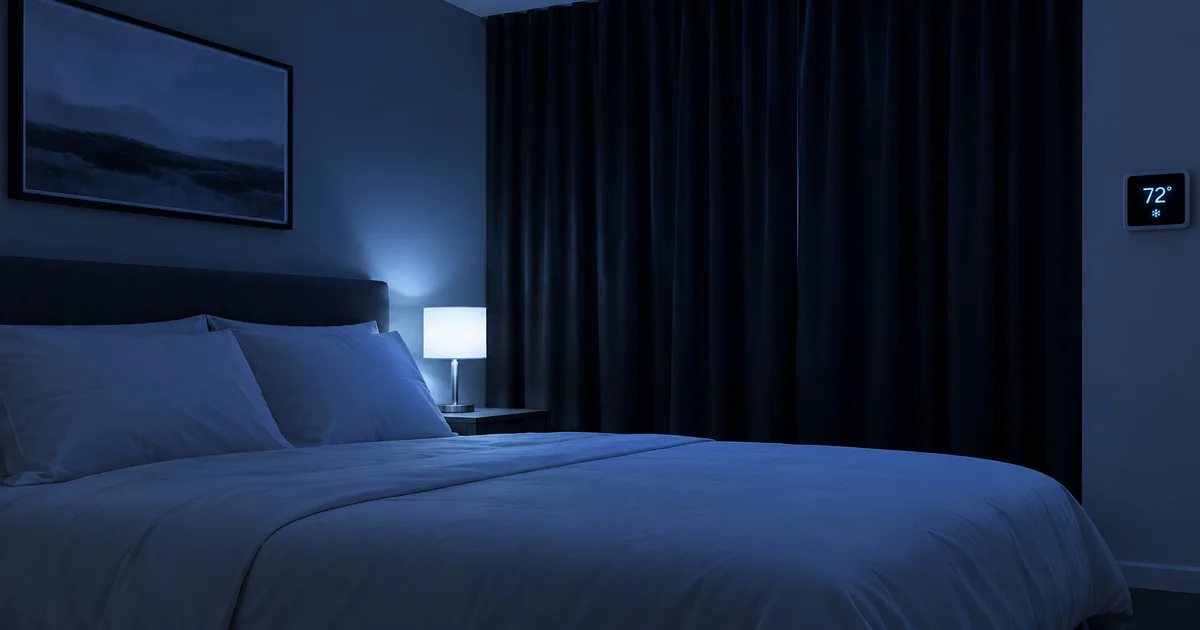
- Light blocking: Install blackout curtains or blinds if external light enters the bedroom from street or outdoor lighting. If this is not immediately feasible, an eye mask provides effective temporary darkness.
- Screen and standby light elimination: Remove or cover devices that emit light during sleep. Consider moving phones and tablets to charge outside the bedroom, or at minimum, face screens toward a wall or cover them.
- Noise baseline: If the sleep environment has intermittent noise intrusions, a background sound source set to a consistent low level may reduce the number of arousal events per night.
Lower-priority refinements: acoustic rugs, earplugs for partner-related noise, and thermal bedding upgrades are worth exploring after the high-priority adjustments are in place, since their individual impact on sleep quality is more variable and harder to predict for a specific individual.
Start with one environmental change at a time. Sleep quality shifts gradually; a change that takes a week to stabilize may appear ineffective in the first two nights. The highest-ROI first step for most people in a bright or noisy urban environment is a blackout window covering.
7. Keep Reading
For the full evidence picture on sleep hygiene — including behavioral factors, substance use, and scheduling — see Sleep Hygiene: An Evidence-Based Guide to Better Sleep.
If you are working on your overall sleep routine alongside your sleep environment, Building a Pre-Sleep Routine That Actually Works covers the behavioral side of wind-down in depth.
For the evidence specifically on napping and its interaction with nighttime sleep drive, Napping: When It Helps and When It Hurts Your Night Sleep addresses how daytime sleep choices affect evening readiness.
8. Frequently Asked Questions
What is the best bedroom temperature for sleep?
No universally optimal temperature exists that applies equally to all adults — thermoregulatory preferences vary with age, body composition, and individual physiology. What the research supports is the general principle that a cooler sleeping environment is associated with better sleep quality for most adults, since it supports the natural core body temperature drop that accompanies sleep onset. If you are unsure where to start, reducing bedroom heat in the evening to below your comfortable daytime waking temperature and using breathable bedding materials is a reasonable starting adjustment. A healthcare provider can offer more tailored guidance if temperature sensitivity is a consistent sleep issue.
Does sleeping with the TV on affect sleep quality?
Television screens emit light during sleep, which research on light exposure during sleep associates with more fragmented sleep and reduced slow-wave sleep in adults. The more significant effect may be the content itself — engaging or emotionally activating content running through the night produces noise and intermittent audio events that can trigger brief arousals. For people who use a television for background sound, a sound-only source (a speaker playing consistent ambient sound) is likely to produce fewer arousal events than intermittent television audio.
Is white noise actually helpful for sleep?
Background sound works by raising the ambient acoustic baseline in the bedroom, which reduces the contrast between quiet baseline and disruptive noise peaks — the spikes that most commonly cause arousal from sleep. The evidence on this approach specifically is limited, but the underlying principle is consistent with research on how noise disrupts sleep architecture. For people in noisy environments where controlling external sound is not feasible, it is a reasonable, low-risk approach to try.
How do I know if my sleep environment is contributing to poor sleep?
One practical indicator is waking at the same time most nights — often associated with consistent external stimuli such as street noise, early morning light, or a home heating system cycling on. Another is waking feeling unrested even after a full night in bed, which can be associated with fragmented sleep that environmental noise or temperature disrupts without producing conscious waking. If improving the environment does not make a meaningful difference over two to three weeks, speaking with a healthcare provider is a reasonable next step.
Do earplugs help with sleep quality?
Earplugs can reduce ambient noise levels meaningfully, which may reduce arousal frequency for people whose sleep is disrupted by intermittent noise. Tolerance and comfort vary considerably between individuals, and some people find consistent earplug use uncomfortable or find that they affect natural auditory awareness in ways that feel disruptive. They are worth trying in noise-exposed situations, particularly when a consistent background sound source is not practical.
References
- Okamoto-Mizuno K, Mizuno K (2012). Effects of thermal environment on sleep and circadian rhythm. Journal of physiological anthropology. https://pubmed.ncbi.nlm.nih.gov/22738673/
- Gooley JJ et al. (2011). Exposure to room light before bedtime suppresses melatonin onset and shortens melatonin duration in humans. The Journal of clinical endocrinology and metabolism. https://pubmed.ncbi.nlm.nih.gov/21193540/
This article was drafted with AI assistance and reviewed and approved by The Psychanatomy Editorial Team before publication.

