

Supporting Article (W1-S6-A2 · 2 of 7) | Dietary Fiber and the Gut Microbiome: What We Know
1. What This Article Covers
Of all the dietary factors that shape the gut microbiome, dietary fiber has the most consistent and best-characterized evidence base. Gut bacteria in the colon ferment dietary fiber into short-chain fatty acids — molecules that nourish the colon lining, regulate local immunity, and influence systemic health. The more and more varied the fiber you eat, the richer and more diverse your gut bacterial community.
This article covers how dietary fiber and the gut interact: what fiber is, how different fiber types affect different bacterial species, what the meta-analysis evidence shows, and what practical dietary patterns emerge from that evidence. For the full overview of how diet shapes the gut microbiome — including fermented foods, overall dietary patterns, and systemic health connections — Gut Health and Diet: What the Science Actually Shows covers the broader landscape.
2. What Dietary Fiber Is
Dietary fiber is the collective name for plant-derived carbohydrates that human digestive enzymes cannot break down. Unlike starch, protein, and fat — which are digested and absorbed in the small intestine — fiber reaches the colon largely intact, where it becomes substrate for gut bacteria.
This is not a failure of digestion. It is the mechanism by which fiber feeds the gut microbiome.
Fiber encompasses a wide range of different molecular structures, each with its own behavior in the gut:
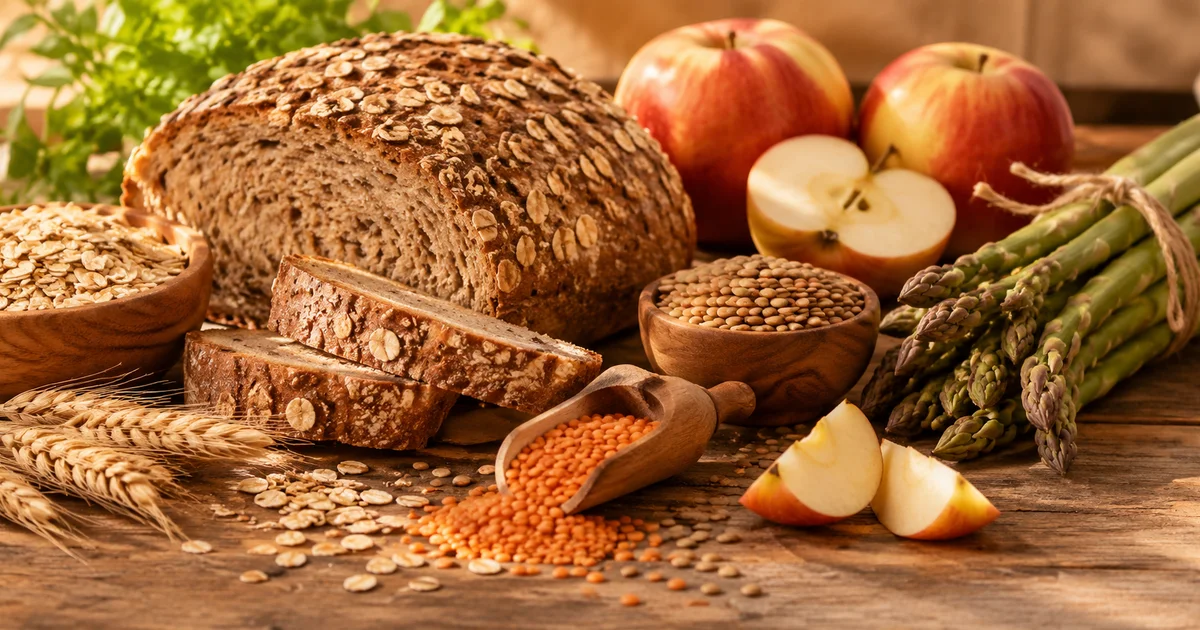
- Soluble fiber (oats, barley, legumes, apples, psyllium) dissolves in water and forms a gel in the small intestine. Highly fermentable, it produces large amounts of short-chain fatty acids and feeds Bifidobacterium and Lactobacillus preferentially.
- Insoluble fiber (wheat bran, vegetable skins, whole grain cellulose) does not dissolve or ferment as readily. It adds bulk to stool and speeds intestinal transit, reducing constipation risk.
- Resistant starch (cooled cooked grains and potatoes, underripe bananas, legumes) resists digestion in the small intestine and ferments slowly in the colon. It preferentially feeds Ruminococcus bromii and Bifidobacterium species, with high butyrate output.
- Inulin and fructooligosaccharides (FOS) (garlic, onion, leeks, chicory, asparagus) are potently prebiotic — they selectively feed Bifidobacterium and Lactobacillus at the expense of less beneficial species. Some of the strongest prebiotic evidence in clinical research involves inulin-type compounds.
- Beta-glucan (oats, barley) is a soluble fiber with both prebiotic and immune-modulating properties, with consistent evidence for LDL reduction alongside gut microbiome effects.
The practical significance of this variety: eating only one type of fiber feeds one subset of bacteria. Covering multiple fiber categories feeds a broader microbial community, which is why plant food variety predicts microbiome diversity better than total fiber quantity alone.
3. How Fiber Shapes Gut Bacterial Communities
The gut microbiome responds to dietary fiber intake in ways that are rapid, measurable, and consistent across research settings. Gut microbiome composition shifts measurably within days of a dietary change — research examining what happens when people switch between high-fiber and low-fiber diets shows bacterial community changes tracking closely with the dietary shift (David et al., 2014). This responsiveness cuts in both directions: more fiber increases diversity-supporting species; a return to low-fiber eating contracts them again.
Systematic review and meta-analysis of dietary fiber interventions in healthy adults finds consistent effects: higher fiber intake reliably increases Bifidobacterium and Lactobacillus — the two bacterial genera most broadly associated with favorable gut health outcomes — with the increases proportional to fiber intake and consistent across different fiber types (So et al., 2018). These are meta-analysis findings, not single-study observations.
The mechanism is fermentation to short-chain fatty acids (SCFAs):
- Fiber reaches the colon intact.
- Gut bacteria ferment it, producing SCFAs — primarily butyrate, propionate, and acetate.
- Butyrate is taken up directly by colonocytes (the cells lining the colon), where it is their preferred energy source and a regulator of gene expression, cell proliferation, and local immune signaling.
- Propionate and acetate enter the portal circulation, reaching the liver and systemic tissues where they influence glucose metabolism, appetite signaling, and inflammatory pathways.
A gut bacteria community producing high SCFA levels from consistent fiber fermentation is associated with a lower-inflammation gut environment, better intestinal barrier function, and favorable metabolic outcomes.
Dietary fiber intake consistently and reliably increases Bifidobacterium and Lactobacillus in the gut microbiota of healthy adults. The fermentation-to-SCFA pathway is well-characterized, and the evidence across multiple fiber types and multiple study designs is consistent.
4. Short-Chain Fatty Acids and What They Do
Short-chain fatty acids — the primary output of fiber fermentation — are the most direct connection between dietary fiber intake and health outcomes beyond stool regularity.
Butyrate is produced mainly from resistant starch and certain soluble fibers. It is the preferred fuel of colonocytes and plays a critical role in maintaining the intestinal barrier — the tight-junction network that separates the colon’s microbial contents from the bloodstream. When butyrate production is low, colonocyte health declines, and the barrier becomes more permeable, allowing bacterial products (endotoxins) to enter the bloodstream and trigger systemic inflammatory signaling.
Propionate is taken up by the liver, where it influences glucose and lipid metabolism. Research links higher propionate production to lower blood glucose responses and modest improvements in lipid profiles.
Acetate enters systemic circulation at the highest concentrations of the three SCFAs. It contributes to appetite regulation (via gut-to-brain signaling) and has anti-inflammatory effects in peripheral tissues.
The practical implication: SCFAs are not just a signal of gut activity — they are the mechanistic bridge between dietary fiber and systemic health effects. A fiber-rich diet that sustains SCFA production is a fiber-rich diet whose effects extend beyond the gut.
5. Fiber Types and Their Specific Effects
Different fiber types do not all have the same gut effects, which is why covering multiple fiber categories consistently — not just chasing one “best” fiber — produces the best microbiome outcomes.
Inulin and FOS are the most studied prebiotic fiber compounds. At doses achieved through ordinary dietary intake of garlic, onions, leeks, and chicory-containing foods, they produce consistent, selective increases in Bifidobacterium. Some research also finds reductions in potentially harmful bacterial species alongside the increases, suggesting a genuine composition shift rather than simple enrichment.
Beta-glucan from oats and barley is the best-evidenced single fiber compound for both gut health and systemic effects, with the strongest and most consistent evidence for LDL-C reduction alongside microbiome-supporting fermentation effects.
Resistant starch produces high butyrate output and selectively feeds Ruminococcus bromii, a keystone butyrate-producing species. Foods high in resistant starch — particularly cooled cooked potatoes, legumes, and underripe bananas — are among the highest butyrate-supporting foods in ordinary diet.
Mixed dietary fiber from vegetables contributes structural diversity — multiple fiber types in one source — that supports broader bacterial diversity than any single purified fiber supplement. This is part of why dietary food sources consistently outperform fiber supplements in microbiome research: whole foods supply multiple fiber types simultaneously alongside polyphenols, vitamins, and minerals that influence bacterial community structure independently.
6. Practical Guidance
How much fiber is the most common question, and the answer is both “it depends on where you start” and “probably more than the average person currently eats.” National dietary guidelines generally suggest 25–38 grams per day for adults (lower estimates for women, higher for men). Average intakes in most Western countries are closer to 15 grams. The gap is wide.
Practical targets by food category: – Two daily servings of legumes (lentils, chickpeas, black beans) → approximately 10–15 grams – Oats or barley for breakfast → 4–6 grams beta-glucan – Three to five vegetables daily → 6–10 grams mixed fiber – One to two servings of whole fruit → 4–6 grams soluble fiber
Combining these routinely — without tracking — typically reaches the 25–30 gram target.
Transition guidance: a sudden large increase in fiber intake almost always causes temporary bloating and gas while the microbiome adjusts to increased fermentation activity. The microbiome adapts within 1–2 weeks, and the symptoms resolve. Gradual increases over 2–3 weeks are more comfortable than a sudden step-change, particularly for people currently eating low-fiber diets.
Water alongside fiber: soluble fiber absorbs water during fermentation, and inadequate fluid intake alongside high fiber intake can paradoxically worsen constipation. Adequate hydration — roughly 8 cups of fluid daily — matters alongside dietary fiber increases.
Fiber supplements vs. food: fiber from whole food sources consistently outperforms isolated fiber supplements in microbiome research. The difference likely reflects the presence of multiple fiber types, polyphenols, and plant matrix in whole foods versus a single purified compound in supplements. Supplements are useful when diet cannot consistently supply adequate amounts; they are not equivalent.
7. Fiber Diversity and the Diversity Outcome
The theme across all fiber research is that diversity of fiber type predicts diversity of gut microbiome better than total fiber quantity alone. This is consistent with the broader principle in microbiome research that it is not any single food or nutrient that most strongly predicts microbiome health, but the breadth of different plant foods in a diet.
For how to build a dietary pattern specifically around gut microbiome diversity — including the plant variety evidence, the 30-plants-per-week benchmark, and practical daily strategies — How to Support Gut Microbiome Diversity Through Diet covers that thread.
8. Keep Reading
For the broader overview of how diet shapes the gut microbiome — including fermented foods, overall dietary patterns, and systemic health effects — Gut Health and Diet: What the Science Actually Shows covers the full evidence landscape.
For the evidence on fermented foods specifically — including what live cultures do in the gut, how the evidence quality varies across fermented food categories, and what the systematic review data shows — Fermented Foods and Gut Health: Evidence Review covers that category in depth.
9. Frequently Asked Questions
Does dietary fiber really change gut bacteria?
Yes — the evidence is both consistent and well-characterized. Dietary fiber interventions in healthy adults consistently increase Bifidobacterium and Lactobacillus species, and gut microbiome composition responds to dietary changes measurably within days. The mechanism is direct: fiber reaches the colon and is fermented by gut bacteria into short-chain fatty acids, and the bacteria best equipped to ferment fiber thrive when fiber intake is high. Increase the fiber, the fiber-fermenting bacteria increase proportionally.
Which fiber is best for gut health?
There is no single best fiber for gut health — different fiber types support different bacterial species and produce different short-chain fatty acids. Inulin and FOS (from garlic and onion) selectively feed Bifidobacterium; resistant starch (from legumes and cooled cooked grains) produces high butyrate; beta-glucan (from oats) has the strongest evidence across both gut and systemic outcomes. Eating a variety of fiber types — from legumes, whole grains, vegetables, and fruit — covers the full spectrum of these benefits in ways no single fiber can replicate.
How much dietary fiber is needed for gut health?
National guidelines suggest 25–38 grams per day, but the more practical target is “significantly more than the average current intake.” Most adults in Western countries eat around 15 grams. Meta-analysis evidence shows consistent microbiome improvements with fiber interventions at intake levels of 20–30 grams and above. The transition matters as much as the target: gradual increases over 2–3 weeks, with adequate fluid intake, are more sustainable than sudden large jumps.
Can fiber cause bloating and gas?
Yes, particularly during rapid increases in fiber intake. The bloating and gas result from the increased fermentation activity — gut bacteria producing more short-chain fatty acids and other fermentation gases as they process the additional fiber. These symptoms are transient, typically resolving within 1–2 weeks as the microbiome adapts to the higher substrate availability. The practical approach is to increase fiber gradually, not all at once, and to maintain adequate fluid intake.
Is fiber from food better than fiber supplements?
For gut microbiome health specifically, dietary food sources consistently outperform isolated fiber supplements in research outcomes. The difference likely reflects the presence of multiple fiber types, polyphenols, and plant matrix in whole foods versus a single purified compound in supplements. For specific clinical purposes — like psyllium for constipation management — a supplement with the right evidence-matched compound is useful. For the microbiome-diversity goal, food first is the consistently better answer.
References
- So, D., Whelan, K., Rossi, M., Morrison, M., Holtmann, G., Kelly, J. T., Shanahan, E. R., Staudacher, H. M., & Campbell, K. L. (2018). Dietary fiber intervention on gut microbiota composition in healthy adults: A systematic review and meta-analysis. The American Journal of Clinical Nutrition, 107(6), 965–983. https://pubmed.ncbi.nlm.nih.gov/29757343/
- David, L. A., Maurice, C. F., Carmody, R. N., Gootenberg, D. B., Button, J. E., Wolfe, B. E., Ling, A. V., Devlin, A. S., Varma, Y., Fischbach, M. A., Biddinger, S. B., Dutton, R. J., & Turnbaugh, P. J. (2014). Diet rapidly and reproducibly alters the human gut microbiome. Nature, 505(7484), 559–563. https://pubmed.ncbi.nlm.nih.gov/24336217/
This article was drafted with AI assistance and reviewed and approved by The Psychanatomy Editorial Team before publication.

