

Supporting Article (W1-S6-A7 · 7 of 7) | How to Support Gut Microbiome Diversity Through Diet
1. What This Article Covers
Supporting gut microbiome diversity through diet is one of the clearest, most actionable takeaways from gut health research. A diverse gut microbial community — one with many different bacterial species performing different functions — is consistently associated with better metabolic, immune, and digestive outcomes than a low-diversity one. And unlike most measures of biological health, microbiome diversity responds directly to dietary changes within days to weeks.
This article explains what gut microbiome diversity means in practical terms, why it matters, and which dietary strategies have the most consistent evidence for building it. For the broader overview of how diet and the gut microbiome interact — from fiber to fermented foods to overall dietary patterns — Gut Health and Diet: What the Science Actually Shows covers the full evidence landscape.
2. What Gut Microbiome Diversity Means
Gut microbiome diversity has several dimensions researchers measure, but two are most practically relevant:
Species richness is the number of different bacterial species present. A higher count generally indicates a more capable community — more functional niches occupied, more types of food components processed, more signaling molecules produced.
Evenness refers to how balanced the relative proportions are among species. A microbiome dominated by one or two species at high abundance — with everything else trace-level — scores low on evenness even if species count is high. High evenness means no single species has crowded out others; the community is functionally distributed.
Low gut microbiome diversity — sometimes called dysbiosis when it reflects a significantly imbalanced or depleted state — is consistently associated with conditions including metabolic syndrome, inflammatory bowel disease, obesity, and type 2 diabetes. High diversity does not cause the absence of disease; the associations are bidirectional, and illness can reduce diversity. But a consistently diverse microbiome is a marker of a well-functioning gut ecosystem, and dietary patterns that support diversity consistently show favorable health associations.
3. Plant Variety as the Foundation
The single most consistent dietary predictor of gut microbiome diversity in population research is plant food variety. Data from the American Gut Project — a large-scale citizen science study of thousands of participants — found that people eating more than 30 different plant types per week had significantly higher gut microbiome diversity compared to those eating fewer than 10 plant types per week, independent of other dietary factors (McDonald et al., 2018). Thirty types is achievable in an ordinary diet and does not require exotic ingredients.
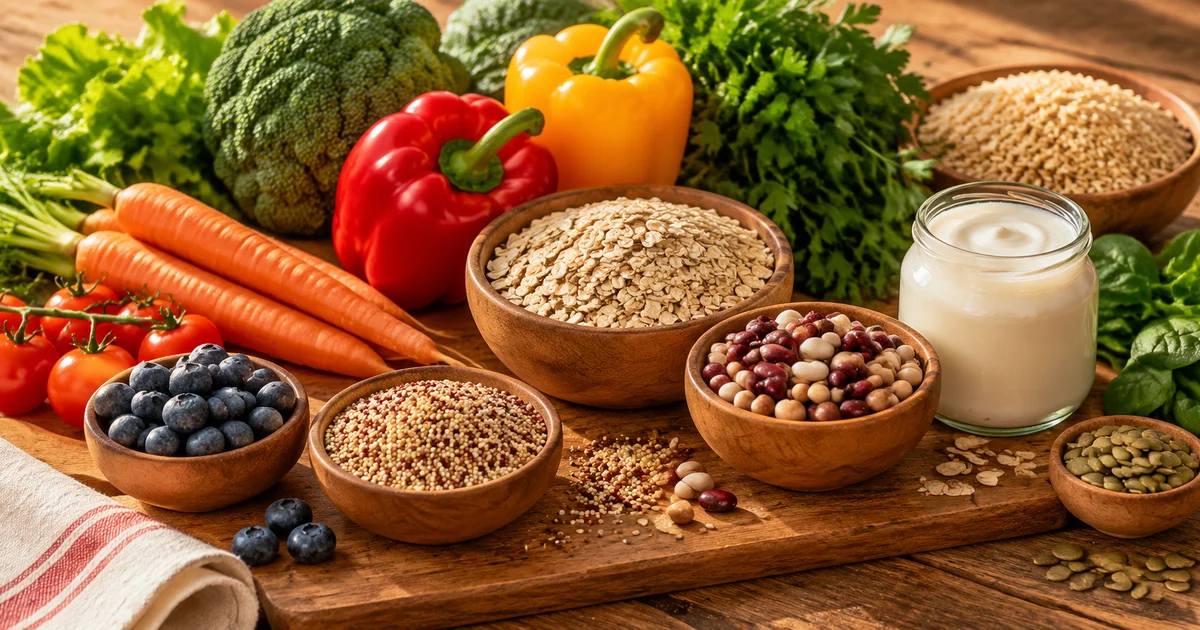
What counts as a plant type: herbs, spices, nuts, seeds, fruits, vegetables, whole grains, and legumes all count. Garlic, onion, and parsley in a single dish contribute three types. Oats, almonds, and blueberries at breakfast contribute three more. The goal is variety across categories, not volume within any single food.
Why variety matters more than quantity: different plant foods contain different fiber structures and polyphenol compounds, which feed different bacterial species. Inulin (from garlic and onions) selectively feeds Bifidobacterium. Beta-glucan (from oats and barley) supports a different set of producers. Resistant starch (from cooled potatoes and underripe bananas) feeds yet another group. No single plant food covers the full spectrum; diversity of food produces diversity of microorganisms.
The polyphenol angle: plant foods also contain polyphenols — the colored compounds in berries, red wine, olive oil, and dark chocolate — which are poorly absorbed in the small intestine and reach the colon where they interact with gut bacteria. Research consistently finds that polyphenol-rich diets are associated with higher gut bacterial diversity, and the relationship appears to be mediated by gut bacteria’s own role in metabolizing these compounds.
Eating more than 30 different plant types per week is associated with significantly higher gut microbiome diversity than eating fewer than 10. Variety across plant categories — not high amounts of any single food — is the key driver.
4. Fermented Foods and Live Microorganisms
Fermented foods contribute to microbiome diversity through a different mechanism than fiber: they introduce live microorganisms directly into the gut environment rather than feeding the ones already there. Regular consumption of fermented foods — particularly dairy ferments like yogurt and kefir — consistently shows associations with higher gut bacterial diversity and reduced inflammatory markers in observational research.
The practical point is that fermented foods and plant variety work through different mechanisms and are most effective together. A diet rich in plant variety creates a gut ecosystem with the substrate and functional niches for the live organisms that fermented foods introduce to settle into. The prebiotic fiber feeds the probiotic organisms; the microorganisms produce the fermentation byproducts that benefit the broader community.
Practical sources: yogurt and kefir with live and active cultures are the most reliably available and best-evidenced options. Traditional, unpasteurized fermented vegetables (refrigerated kimchi and sauerkraut, not shelf-stable) provide lactic acid bacteria alongside the prebiotic fiber of the vegetables themselves. Miso and certain aged cheeses contribute smaller amounts of live cultures.
The pasteurization distinction matters: commercially shelf-stable fermented products are typically pasteurized after fermentation, which kills the microorganisms. The fermented flavor develops before pasteurization; it is the live organisms that are absent after. For microbiome-supporting purposes, the live-culture label or refrigerated unpasteurized status matters.
5. Fiber Diversity and Fermentation
Gut bacteria feed on fiber through fermentation — converting it into short-chain fatty acids (SCFAs), particularly butyrate, propionate, and acetate. These are the primary outputs of a healthy, fiber-fed microbiome: they nourish the colon lining, regulate local immune signaling, and serve as signaling molecules that influence systemic metabolic function. Gut microbiome composition shaped by dietary fiber intake influences energy metabolism and metabolic health outcomes in ways that extend beyond the gut itself (Carmody & Bisanz, 2023).
The key point for diversity is that different fiber types support different bacterial species and produce different SCFA profiles. A diet supplying only one fiber type — say, wheat bran — feeds one set of producers well and others not at all. Diversity of fiber type produces diversity of bacterial species; the two are functionally linked.
Fiber categories and their primary sources: – Soluble / gel-forming fibers (oats, barley, legumes, apples) — slow digestion, high SCFA production, strongly prebiotic – Insoluble fibers (whole wheat bran, vegetable skins) — accelerate transit, increase stool bulk – Resistant starch (cooled cooked grains/potatoes, underripe bananas) — highly fermentable, selectively feeds Bifidobacterium and Ruminococcus – Inulin / FOS (garlic, onions, leeks, chicory root) — potently prebiotic, strongly favors Bifidobacterium – Pectin and polyphenol-associated fibers (berries, apples, citrus peel) — fermented by a diverse bacterial community, associated with high diversity
Covering multiple fiber categories — through consistent dietary variety rather than a supplement protocol — is both more achievable and more consistent with the research on microbiome diversity outcomes.
6. Dietary Patterns That Reduce Microbiome Diversity
Building a diverse microbiome is partly about what to include and partly about what to reduce. Several dietary patterns consistently associate with lower gut microbiome diversity in population research:
Ultra-processed food dominance is the most consistent inverse predictor of gut microbiome diversity. Highly processed foods — those where most of the natural fiber matrix has been removed and replaced with additives — supply almost no substrate for gut bacteria. A gut fed primarily on refined and ultra-processed foods becomes a low-diversity environment by substrate starvation.
Very low-fiber eating produces the same result through direct mechanism: without fermentable substrate, the bacterial community that depends on fermentation contracts over time. Research suggests that the microbiome adapts to a low-fiber diet within days, with diversity-supporting species declining relatively quickly.
Antibiotic use disrupts the microbiome acutely, reducing diversity significantly during treatment. Recovery happens but is typically incomplete — some diversity lost to antibiotics is not fully recovered without deliberate dietary support. After an antibiotic course, a fiber-rich, plant-diverse, fermented-food-inclusive diet supports faster and more complete recovery.
Highly repetitive eating patterns are relevant even when individual foods are healthy. The same rotation of five vegetables, eaten daily, feeds the same bacterial species well and others not at all. Diversity-supporting eating means rotating across the range of plant categories consistently, not eating large amounts of a narrow set.
7. Building a Practical Diversity Framework
Achieving 30+ plant types per week is a practical goal that most people can reach within ordinary meal patterns.
Count categories, not servings. Garlic, onion, and thyme in a pasta sauce count as three plant types — not three servings of anything. Herbs, spices, seeds, and nuts count. This reframing makes the goal less intimidating: a dish using five vegetables, two spices, and a legume contributes eight types in one meal.
Rotate staples within categories. Switching between oats and barley at breakfast, between lentils and chickpeas in a salad, between apple and pear as a snack — rotations within familiar categories cover diversity without requiring new cooking skills or exotic ingredients.
Add a fermented food daily. A serving of yogurt, kefir, or unpasteurized kimchi alongside a meal creates a consistent live-culture input. The fermented food works better in the context of the plant variety, so the two habits support each other.
Reduce ultra-processed food proportion. This matters not because ultra-processed foods are acutely harmful in small amounts, but because they crowd out the plant foods and fermented foods that feed microbiome diversity. The goal is proportion, not complete elimination.
For people whose gut symptoms — bloating, loose stools, or abdominal discomfort — make it challenging to increase plant variety quickly, Common Digestive Discomforts and Dietary Factors covers how to identify food sensitivities and manage the transition through higher-fiber eating.
8. Keep Reading
For the full evidence picture on how diet shapes the gut microbiome — including the role of fermented foods, fiber, and overall dietary patterns — Gut Health and Diet: What the Science Actually Shows covers the landscape.
For the specific research on how dietary fiber reshapes gut bacterial communities — including which fiber types do what, and what the meta-analyses show — Dietary Fiber and the Gut Microbiome: What We Know covers that thread in depth.
9. Frequently Asked Questions
How quickly can diet change gut microbiome diversity?
Gut microbiome composition responds to dietary changes within days. Increasing plant variety and fermented food intake begins shifting bacterial community structure measurably within one to two weeks. Achieving stable, higher diversity takes longer — typically weeks to months of consistent dietary patterns. The reverse is also true: a sudden shift to low-fiber, high-processed eating can reduce diversity within days. The microbiome is highly responsive to current diet rather than fixed by long-term history.
How do you count 30 plant types per week?
Count every distinct plant food: each vegetable, fruit, whole grain, legume, nut, seed, herb, and spice counts as one type. A single meal using onion, garlic, tomato, bell pepper, lentils, and parsley contributes six types. The count resets weekly. Most people reaching 30 types are doing so through accumulation across meals and snacks rather than a deliberate tracking system — a simple mental tally or occasional one-week log helps calibrate whether you are in the ballpark.
Is gut microbiome diversity always better?
Higher diversity is consistently associated with favorable health outcomes in population studies, and the association is robust across multiple conditions. This does not mean that higher diversity is always better in every clinical context — specific probiotic treatments for specific conditions may work precisely because they alter composition rather than just increase richness. For general dietary guidance in healthy adults, more diversity reliably associates with better outcomes across the available evidence. The practical guidance to eat more plant variety and fermented foods is well-supported regardless of the nuance in edge cases.
Do probiotics increase gut microbiome diversity?
Probiotic supplements introduce specific strains, which can transiently increase diversity during active use. The effect on long-term resident diversity is modest and inconsistent — most introduced strains do not permanently colonize the gut unless the existing environment is unusually disrupted. Fermented foods introduce live cultures alongside a food matrix and prebiotic substrate, which appears to support more durable integration than supplements alone. The stronger and more consistent dietary predictor of diversity remains plant food variety, not probiotic supplementation.
Does microbiome diversity decline with age?
Yes, in population research, gut microbiome diversity tends to decline with age, with the most marked changes observed in older adults. Dietary factors are significant contributors to this — older adults tend to eat less varied, lower-fiber diets. The age-related decline is not inevitable and is modifiable by diet; people eating diverse, plant-rich diets in older age consistently show higher diversity than age-matched peers on less varied diets.
References
- McDonald, D., Hyde, E., Debelius, J. W., Morton, J. T., Gonzalez, A., Ackermann, G., Aksenov, A. A., Behsaz, B., Brennan, C., Chen, Y., DeRight Goldasich, L., Dorrestein, P. C., Dunn, R. R., Fahimipour, A. K., Gaffney, J., Gilbert, J. A., Gogul, G., Green, J. L., Hugenholtz, P., … Knight, R. (2018). American Gut: An open platform for citizen science microbiome research. mSystems, 3(3), e00031-18. https://pubmed.ncbi.nlm.nih.gov/29795809/
- Carmody, R. N., & Bisanz, J. E. (2023). Roles of the gut microbiome in weight management. Nature Reviews Microbiology, 21(8), 535–550. https://pubmed.ncbi.nlm.nih.gov/37138047/
This article was drafted with AI assistance and reviewed and approved by The Psychanatomy Editorial Team before publication.

