

Supporting Article (W1-S4-A2 · 2 of 7) | Grocery Shopping for Balanced Nutrition: A Practical Guide
Grocery shopping is where the weekly meal plan meets reality. How you approach the shop — what you put on the list, how you navigate the store, what you stock consistently — shapes what ends up in your kitchen and, in turn, what you eat throughout the week. Research on home cooking frequency and dietary intake finds that people who cook dinner at home more than six times per week consume substantially more vegetables than those who cook fewer than twice per week (Wolfson & Bleich, 2015). What you buy on the weekly shop is a primary driver of that outcome. This article is a companion to How to Build a Sustainable Meal Planning Habit, which covers the broader planning process; this article goes deeper on the grocery stage specifically.
1. What This Article Covers
This article is about practical grocery shopping strategies for people who want to eat well consistently — not perfectly, but reliably. It covers how to build a pantry foundation, how to organize a shopping trip, how store environments influence what people buy, and how to navigate the shop with less friction.
It does not cover which specific foods to eat for a particular health goal — that level of individualization falls outside general informational guidance.
2. Building a Pantry Foundation
One of the most effective things you can do for consistent healthy eating is to maintain a stocked pantry of shelf-stable and frozen staples. When you have a reliable foundation of ingredients, any planned meal is simpler to execute and gaps in fresh supply are easier to fill.
A functional pantry foundation typically includes:
Whole grains and starches. Brown rice, quinoa, rolled oats, whole-grain pasta, lentils, and dried or canned beans are versatile, long-shelf-life staples that form the base of a large variety of meals. Keeping two or three varieties means you can build a nutritious base for almost any meal without an urgent shopping trip.
Proteins. Canned fish (tuna, salmon, sardines), canned legumes (chickpeas, black beans, kidney beans), and eggs are shelf-stable or long-lasting protein sources that require no preparation advance planning. Frozen chicken, fish, or tofu also serve this role with minimal space.
Vegetables and fruit. Frozen vegetables retain most of their nutritional content and do not spoil. Keeping a variety of frozen vegetables — spinach, mixed vegetables, edamame, broccoli — means you always have vegetables available even when fresh produce runs low. Canned tomatoes and tomatoes-based products are another useful staple. Fresh produce should rotate through on a weekly shopping cycle.
Oils, acids, and aromatics. Olive oil, vinegar, garlic, onions, canned tomatoes, and a small selection of dry spices are what make simple ingredients taste deliberate. These do not require weekly restocking and form the flavor foundation of most home cooking.
A pantry built on these categories does not require an exhaustive weekly shop. It needs restocking occasionally, and the weekly shop focuses on fresh produce, fresh proteins, and replacing what has been used.
3. How Store Environments Influence Purchasing
Grocery stores — both physical and digital — are structured environments where product placement, pricing, and design choices consistently influence what shoppers purchase. This is not speculative: systematic review evidence on marketing practices in grocery shopping finds that promotional pricing, shelf placement, and digital nudging strategies reliably affect what people select (Hodges et al., 2023).
The most practical thing to know about store design is that the most heavily promoted and prominently placed items are rarely the most nutritious. High-margin processed foods tend to be at eye level, in endcap displays, and near checkout. Fresh produce and minimally processed staples tend to be at the perimeter of physical stores — but this layout is not universal, and online platforms use different promotional mechanisms including banner ads, featured product slots, and algorithmically determined defaults.
There are a few simple ways to reduce the influence of store design on your purchasing:
Shop from a list. A list built from your planned meals limits the decisions you make in the store to whether specific items are available, rather than what to put in the basket. Unplanned decisions in a store environment are more susceptible to promotional placement and impulse purchasing than decisions made outside the store environment.
Shop when you are not hungry. Hunger increases attentiveness to high-calorie, high-reward foods. If shopping shortly after a meal is not possible, a small snack before the shop reduces this effect without requiring willpower during the trip.
Be skeptical of “healthy” labeling. Health claims on packaging — “natural,” “light,” “grain” — are marketing descriptors, not nutritional standards. Reading the actual nutrition information rather than relying on front-of-pack labeling gives a more accurate picture of what a product contains.
4. The Practical Shopping Trip
A well-organized shopping trip follows the list, starts with the least perishable items, and ends with fresh produce and proteins so they spend the least time outside refrigeration.
Before you go. Write a list from your planned meals and a quick scan of what is running low in your pantry. Organize the list by section of the store if you shop at the same store regularly — it reduces time spent retracing steps and decisions made off-list.
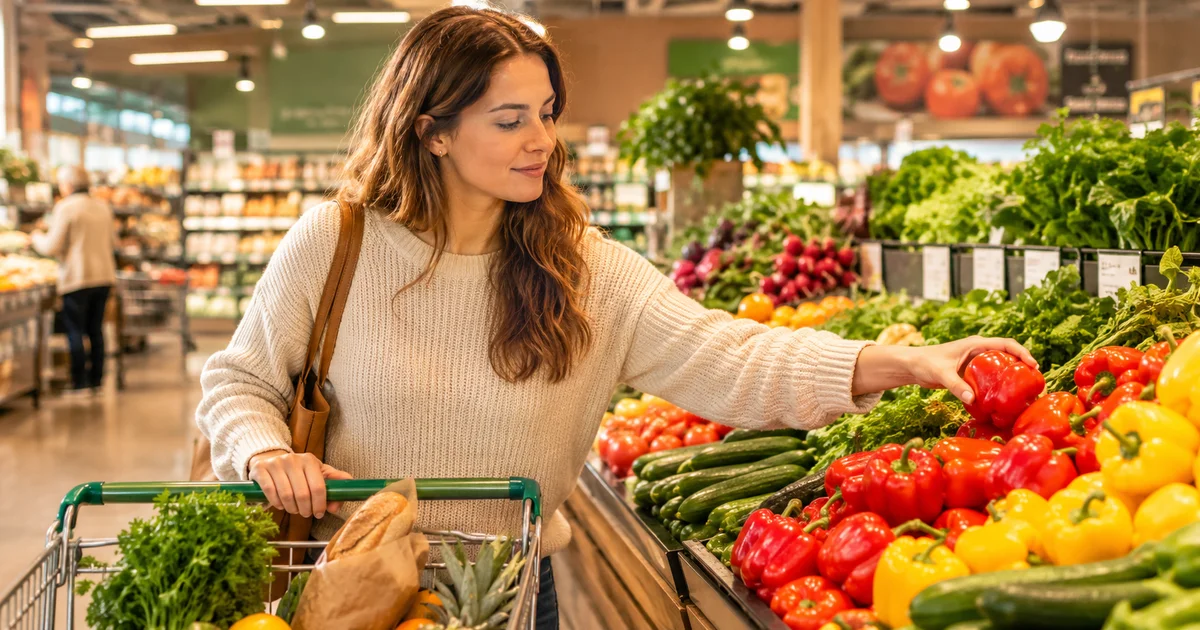
In the produce section. This is typically where varied, nutrient-dense choices are made. Prioritize variety — aiming for a range of colors across vegetables and fruit is a practical proxy for variety in vitamins, minerals, and phytonutrients. If fresh produce is expensive or inconsistent in quality that week, frozen is a nutritionally sound alternative.
At the protein counter or aisle. For proteins, fresh fish, chicken, and eggs alongside canned and dried legumes cover most weekly needs. If you are buying multiple days of fresh protein at once, consider which items can be cooked in a batch session on the same day — buying the same cut in a larger quantity is usually cheaper and simplifies the week.
Label reading in the processed foods aisles. For packaged items, the ingredients list is more informative than front-of-pack claims. Ingredients are listed in order of weight — if the first several ingredients include forms of added sugar or refined grain, the product is primarily composed of those things regardless of what the front label states. Sodium and saturated fat are the two figures most consistently worth checking.
5. Fresh Produce, Variety, and Seasonal Considerations
Fresh produce is both the highest-nutritional-value and the most time-sensitive category of a grocery shop. Rotating what you buy from week to week — rather than purchasing the same items every time — expands your dietary variety without requiring any change to your overall approach.
A simple rotation strategy is to keep one familiar vegetable and add one unfamiliar or seasonal one each week. Over the course of a month, this naturally introduces several varieties into the kitchen that might not have been there otherwise, and seasonal produce is typically better value and in better condition than out-of-season equivalents.
Seasonal availability varies by region and climate, but the general pattern holds: buying vegetables and fruit that are currently in season in your location tends to result in better flavour, lower cost, and produce that has spent less time in storage or transit.
Frozen vegetables are always in season in this sense — they are typically frozen close to harvest and retain most of their nutritional content throughout their shelf life. For several commonly consumed vegetables (peas, corn, spinach, mixed stir-fry vegetables), frozen can be nutritionally equivalent to or better than fresh produce that has been stored for several days.
6. What Helps and What Gets in the Way
The most common obstacle to consistent, nutrition-oriented grocery shopping is not lack of knowledge but lack of time, energy, or access. These obstacles are real and vary significantly by household situation.
Time pressure. A weekly shop for a household with a clear list typically takes 30 to 45 minutes. If this is not available in a single session, splitting the shop — a weekly main trip and a mid-week top-up for produce — is more sustainable than trying to condense everything. Online grocery shopping can reduce the time cost further, though evidence suggests it also changes the experience of choosing and may reduce exposure to fresh produce in ways that require deliberate compensation.
Budget. A nutritious diet does not require expensive foods. Frozen vegetables, dried legumes, whole grains, eggs, and canned fish are among the most nutritious and least expensive foods available in most grocery stores. For people managing food budgets carefully, building around these staples and supplementing with fresh produce during sales or in season substantially reduces cost without reducing nutritional quality.
Access. Not all grocery stores carry the same products, and geographic and economic access to full-service grocery stores varies. For people with limited access to physical stores, online grocery delivery and larger monthly shopping trips with a freezer-based model can serve as practical alternatives. For more on managing portion awareness within what is available to you, see Portion Awareness: Understanding Amounts Without Obsessive Tracking.
7. Keep Reading
This article covers grocery shopping as one component of a weekly food system. For the broader planning process — including how to build a weekly review habit, a five-step planning framework, and a planning checklist — see How to Build a Sustainable Meal Planning Habit.
For guidance on how to use what you buy efficiently through advance preparation, Batch Cooking Basics: Saving Time While Eating Well covers the practical mechanics of preparing ingredients and meals in advance to reduce friction during the week.
8. Frequently Asked Questions
How should I organize my shopping list?
Organizing a list by store section — produce, proteins, dairy or alternatives, dry goods, frozen — reduces time in the store and minimizes the number of unplanned decisions made in unfamiliar aisles. For people who shop at the same store regularly, learning its layout and mapping the list accordingly is a minor effort with a consistent return. For online shopping, organizing by category achieves the same goal of moving through the shop systematically rather than browsing broadly.
Is organic produce worth buying for nutritional reasons?
The evidence on nutritional differences between organic and conventionally grown produce does not currently support strong conclusions. The practical guidance most consistent with available research is to prioritize variety and volume of produce over organic status — eating more vegetables and fruit consistently matters more than which production method was used. If organic produce fits your budget and preferences, that is a reasonable choice; if the premium is not affordable, conventionally grown produce is nutritionally sound.
Does buying in bulk save money and reduce waste?
Buying in bulk is cost-effective for shelf-stable, non-perishable items you use regularly — whole grains, dried legumes, oats, canned goods, olive oil. It is less useful for perishables that you cannot use in sufficient quantity before spoilage. The rule of thumb is to buy bulk only what you will consistently use within a reasonable time frame, and to have adequate storage. For households cooking for one or two people, buying in bulk for produce or fresh proteins tends to increase waste rather than reduce it.
How do I shop for nutritious food on a limited budget?
The most cost-effective nutritious foods are frozen vegetables, dried or canned legumes, eggs, canned fish, and whole grains. These are nutritionally dense and significantly cheaper per serving than most fresh proteins and produce. Building meals around these staples and supplementing with seasonal fresh produce keeps costs low without compromising nutritional quality. Sales and store brands for these categories follow the same nutritional profile as name brands and are worth using.
References
- Hodges, L., et al. (2023). A Systematic Review of Marketing Practices Used in Online Grocery Shopping: Implications for WIC Online Ordering. Nutrients, 15(3), 544. https://pubmed.ncbi.nlm.nih.gov/36678317/
- Wolfson, J. A., & Bleich, S. N. (2015). Fruit and vegetable consumption and food values: differences among adults who do and do not cook at home. Preventive Medicine, 76, 1–7. https://pubmed.ncbi.nlm.nih.gov/25847732/
This article was drafted with AI assistance and reviewed and approved by The Psychanatomy Editorial Team before publication.

