

Supporting Article (W1-S2-A4 · 3 of 6) | Whole Foods vs. Ultra-Processed Foods: Understanding the Difference
1. What This Article Covers
If you have tried to make sense of food labels or understand what “processed” actually means for your health, you are not alone. The whole foods vs ultra processed foods distinction is real and meaningful — but it also gets oversimplified in popular discussions. This article focuses specifically on what researchers mean by these categories, how the NOVA food classification system works, and what the evidence actually shows.
For broader context on how food choices fit into overall dietary patterns and long-term health, see Evidence-Based Dietary Patterns: What the Research Actually Shows. That article covers the wider landscape of evidence across multiple dietary approaches.
2. What the NOVA Classification Is
The NOVA classification was developed by researchers at the University of São Paulo, led by Carlos Monteiro, as a framework for categorizing foods based on the extent and purpose of their industrial processing — not their nutrient content. This distinction is important: NOVA is not a nutritional scoring system. It characterizes how foods are made, not what nutrients they contain.
NOVA divides foods into four groups:
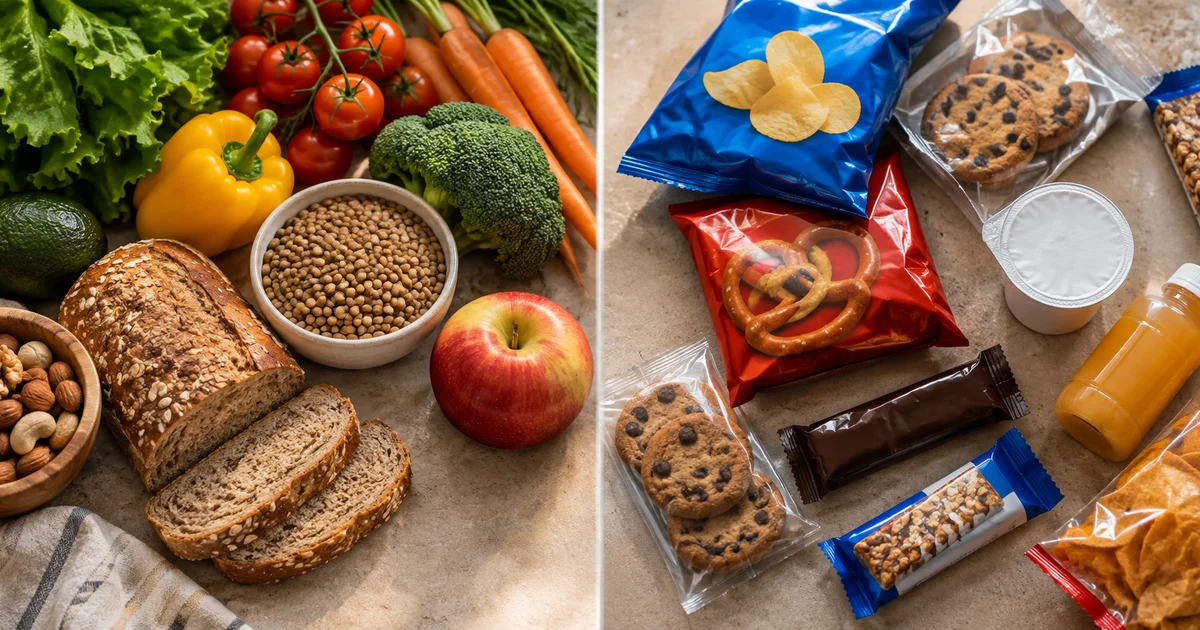
- Group 1 — Unprocessed or minimally processed foods: Fresh fruits, vegetables, legumes, plain meats, eggs, plain milk, unsalted nuts and seeds, and similar foods with little or no industrial modification.
- Group 2 — Processed culinary ingredients: Items like oils, flours, salts, and sugars — extracted from Group 1 foods and used in cooking, not typically eaten alone.
- Group 3 — Processed foods: Combinations of Group 1 and Group 2 items, such as canned fish, cheese, cured meats, or freshly baked bread. These have been altered for preservation or taste but remain recognizable as food.
- Group 4 — Ultra-processed foods: Industrial formulations made mostly or entirely from substances extracted from foods, with little or no whole-food content. These typically contain additives — emulsifiers, flavor enhancers, colorants, and stabilizers — not normally found in home cooking. Examples include packaged snack foods, carbonated soft drinks, mass-produced packaged breads, instant noodles, and many ready-to-eat products.
NOVA’s fourth group is what most research on whole foods vs ultra processed foods focuses on.
3. What the Evidence Shows
The bulk of the evidence on ultra-processed food intake comes from large observational cohort studies — studies that track dietary patterns and health outcomes over years or decades. These studies are well-suited to capturing real-world eating patterns, but they show associations, not causation. Other factors that influence both diet and health can affect what these studies find.
With that context, the pattern of findings is consistent. Higher ultra-processed food consumption is associated with elevated all-cause mortality, cardiovascular mortality, and a range of metabolic and disease outcomes across multiple independent study populations (Suksatan et al., 2022). Separately, evidence from systematic reviews of meta-analyses shows that high whole grain intake — a hallmark of whole-food eating — is associated with reduced risk of several cancers (Gaesser, 2020). Dietary patterns characterized by higher whole-food intake are also associated with reduced colorectal cancer incidence (Veettil et al., 2021).
The strength of the evidence against high ultra-processed food intake comes from the consistency of associations across many independent studies and populations. No single study establishes causation, but the convergent pattern is meaningful. At the same time, the research does not mean that eating any ultra-processed food is dangerous — it reflects patterns of dietary intake over time, not individual food events.
4. How Ultra-Processing Changes Food
Ultra-processing changes food in ways that extend well beyond simply making it last longer. Several mechanisms have been proposed to explain why high ultra-processed food intake is associated with negative health outcomes in observational research.
Fiber reduction. Most ultra-processing removes or substantially reduces dietary fiber. Whole grains processed into refined flour lose most of their fiber content. Fiber is essential for gut microbiome diversity, satiety, blood sugar regulation, and bowel function. Populations with higher ultra-processed food intakes tend to have lower overall fiber consumption.
Additive exposure. Ultra-processed foods often contain industrial additives — emulsifiers, artificial sweeteners, colorants, and preservatives — that are not part of traditional food preparation. Some research has raised questions about whether certain emulsifiers and sweeteners affect gut microbiome composition and metabolic function, though the evidence remains early and the picture is not settled.
Displacement. Perhaps the most direct mechanism is nutritional displacement. When ultra-processed foods make up a large share of calorie intake, they replace whole foods that would otherwise contribute nutrients, fiber, and phytochemicals. The problem may be as much about what they crowd out as what they directly cause.
5. Common Misconceptions
“All processing is unhealthy.” This is not what the evidence shows, and NOVA itself does not make this claim. Processing includes everything from washing lettuce to making canned tomatoes — activities that extend shelf life, improve safety, and increase food access. The concern is specifically with Group 4 ultra-processing, not processing in general. Frozen vegetables, canned legumes, plain yogurt, and traditionally made cheeses are all processed foods with well-established nutritional value.
“Natural means whole.” Many products marketed as natural, clean, or minimally processed fall into Group 4 under NOVA. A granola bar made with oats and honey still often contains emulsifiers, refined sugars, and stabilizers. Marketing language is not the same as food classification.
“Ultra-processed food avoidance means cooking every meal from scratch.” The practical goal is to shift the overall balance of food intake — not to eliminate every convenience product. Many minimally processed packaged foods (plain oats, canned beans, plain frozen fish) are fully consistent with a whole-food-oriented dietary pattern.
6. Practical Guidance
The evidence supports reducing ultra-processed food intake as part of a broader dietary quality improvement, not as an isolated single-food elimination effort. Three practical shifts that move dietary intake in a meaningful direction:
1. Replace packaged snack foods with whole-food alternatives. Swapping chip-style snacks or packaged cookies for fresh fruit, nuts, or plain yogurt reduces Group 4 exposure while increasing fiber and nutrient density. This is one of the most straightforward practical shifts available.
2. Choose whole grains over refined grain products. Whole grain breads, oats, brown rice, and similar products are Group 1 or Group 3 depending on their additives — and the research on whole grain intake and health is among the most consistent in nutritional epidemiology. Reading ingredient lists helps: “whole wheat” as the first ingredient is a different product from “enriched wheat flour.”
3. Cook more with Group 1 ingredients. Meals built primarily around fresh or frozen vegetables, legumes, whole grains, and plain proteins naturally shift the dietary pattern toward whole foods. This does not require elaborate cooking — simple meals with fewer processed components consistently reduce Group 4 exposure.
A useful audit: review a typical week of eating and identify your top five sources of Group 4 ultra-processed foods by volume. Replacing just two or three of these with minimally processed alternatives often produces a meaningful dietary shift without requiring whole-diet restructuring.
7. Keep Reading
The whole foods vs ultra processed foods distinction is one component of the broader dietary quality picture examined in Evidence-Based Dietary Patterns: What the Research Actually Shows, which covers how food pattern choices connect to long-term health outcomes.
For readers interested in building a dietary approach around more whole plant foods, Plant-Based Eating: A Practical Introduction covers how plant-forward eating naturally intersects with whole-food principles.
Understanding when and how frequently you eat — not just what you eat — is a related thread explored in Meal Timing and Eating Frequency: What the Research Shows.
8. Frequently Asked Questions
What makes a food “ultra-processed” under NOVA?
Under the NOVA classification, ultra-processed foods are industrial formulations that contain little or no whole food and include additives not commonly used in home cooking — such as emulsifiers, flavor enhancers, colorants, and stabilizers. The key feature is not any single ingredient but the industrial process that produces the food. Many packaged products with long ingredient lists including chemical-sounding names fall into this category, though ingredient-list length alone is not the defining criterion.
Are all ultra-processed foods equally harmful?
The research on ultra-processed foods is based on overall consumption patterns across populations, not individual product-level findings. It does not establish that every Group 4 product is equally associated with negative health outcomes, nor does it establish a specific consumption threshold. The associations observed in cohort studies reflect dietary patterns over time. Reducing ultra-processed food intake overall — rather than eliminating any single product — is what the evidence most clearly supports.
Is white bread really ultra-processed?
Mass-produced packaged white bread typically falls into Group 4 under NOVA because it often contains emulsifiers, dough conditioners, and other additives not found in traditionally made bread. A plain artisan sourdough made from flour, water, salt, and starter would typically fall into Group 3. The distinction is not about white versus whole wheat flour, but about whether industrial additives are present. Reading the ingredient list is more informative than color or marketing labels.
Does eating ultra-processed food occasionally matter?
The observational evidence is based on habitual dietary patterns over time, not isolated food events. Research does not support the conclusion that eating an ultra-processed food occasionally causes harm in the same way that long-term high consumption is associated with negative outcomes in epidemiological studies. The health-relevant question is about the overall balance and frequency of ultra-processed food intake across a typical week or month, not individual meals or days.
References
- Gaesser, G. A. (2020). Whole grains, refined grains, and cancer risk: A systematic review of meta-analyses of observational studies. Nutrients, 12(12), 3756.
- Veettil, S. K., et al. (2021). Role of diet in colorectal cancer incidence: Umbrella review of meta-analyses of prospective observational studies. JAMA Network Open, 4(2), e2037350.
- Suksatan, W., et al. (2022). Ultra-processed food consumption and adult mortality risk: A systematic review and dose–response meta-analysis of 207,291 participants. Nutrients, 14(1), 174.
This article was drafted with AI assistance and reviewed and approved by The Psychanatomy Editorial Team before publication.

